Education
Leadership transitions timed to the academic year.
Why succession planning is different in education
K-12 leadership pipelines run on certification and geography. Principals come from assistant principals who hold the right administrative credential, superintendents come from cabinet roles and principalships, and every step is gated by state licensure that takes semesters, not weekends, to complete. A district's real bench is its AP corps, and most districts have never assessed it systematically: who could take a building next year, who needs two more years and a credential, and which schools have no coverage at all. Superintendent transitions add board-run searches, community visibility, and interim appointments that can stretch across a school year when no internal candidate is ready.
Higher education has a different shape and the same problem. Chairs and deans are drawn from faculty, many of whom never planned on administration, and rotating-chair models mean the pipeline question never stops: someone credible has to be ready every cycle. Dean and provost transitions run through committee processes on academic-year timelines, and external searches compete for a small pool of people willing to leave tenure lines elsewhere. Developing academic leaders internally, on honest readiness timelines, is usually the only dependable supply, and it works better when it starts before the incumbent announces a return to faculty.
Then there is the calendar. Education transitions land on July 1 or they land badly, which compresses every search and handover into a predictable season. Planning windows should map to school years rather than fiscal quarters: Ready Now means ready for this coming July, and a 2 to 3 year window means two full academic cycles of development. Board and committee governance adds the final constraint. Plans get reviewed in settings adjacent to public scrutiny, so the process behind a leadership decision needs documentation strong enough to survive a pointed question at a board meeting.
The roles education plans have to cover
From the district cabinet to the campus, the pattern repeats: certification gates, committee governance, and a calendar that punishes late transitions.
Superintendents and cabinet leaders
Board-run transitions with community visibility and real interim costs. A Ready Now internal candidate can turn a year of interim leadership into a summer handover.
Principals and assistant principals
The largest leadership layer in any district and the most certification-gated. The AP-to-principal pipeline is the district's succession plan, whether or not anyone is managing it.
Deans and department chairs
Rotation cycles and committee searches make this a standing need rather than an occasional one. A scored view of who is credible and willing beats the hallway shortlist every cycle.
Business officials and operations directors
Facilities, finance, transportation, IT: one-deep roles that keep schools open and rarely appear in leadership planning until the resignation arrives.
Every administrator, one roster.
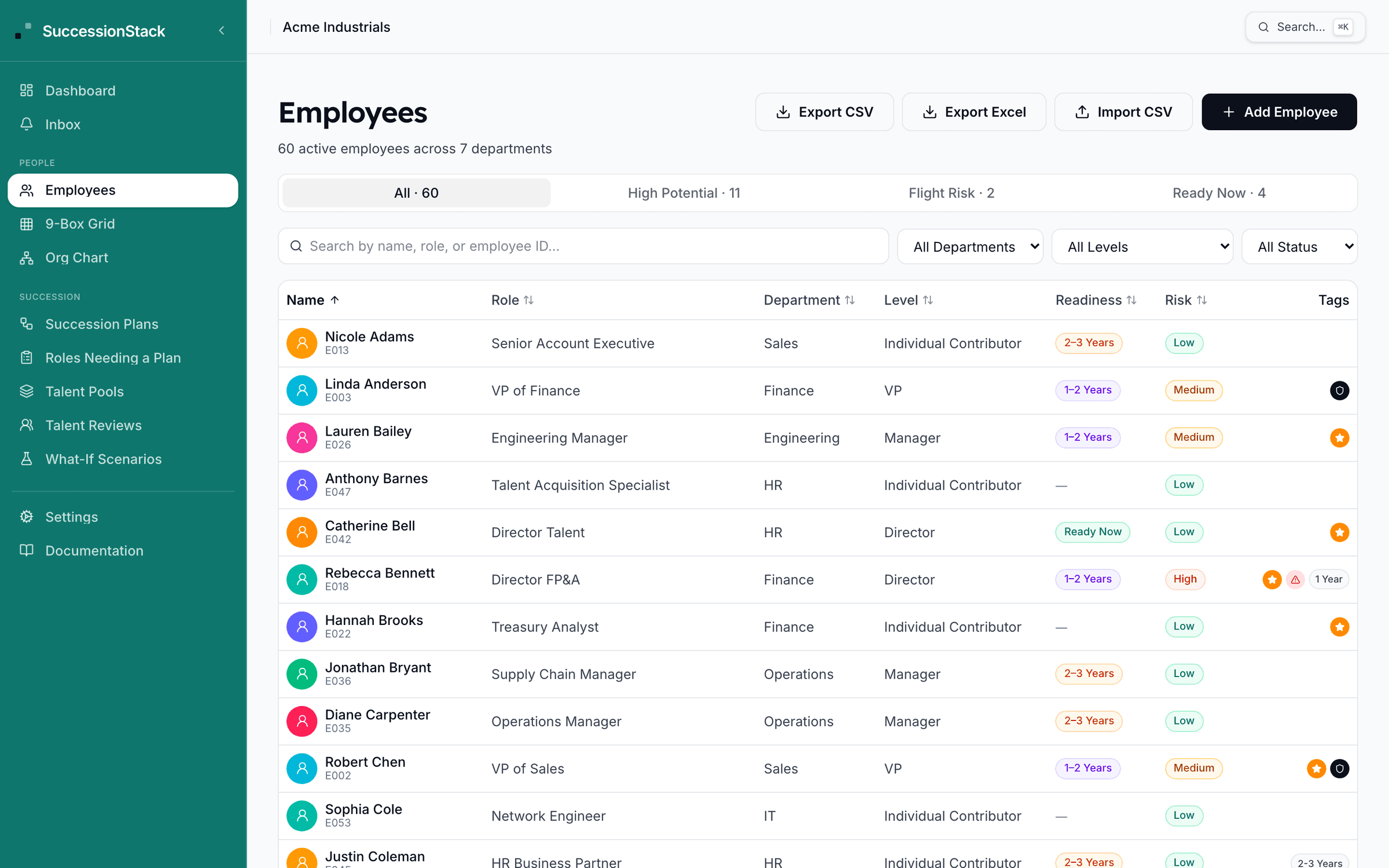
The talent database holds your whole leadership population from a CSV import: district cabinet and building leaders, or faculty and academic administrators, scored on eight dimensions with weights that fit the seat (instructional leadership weighs differently for a principal than for a business official). Readiness windows map cleanly to school years, so when a principalship opens in March, the question of who is ready for July has an answer with evidence behind it instead of a scramble.
How districts and institutions get live
Live inside a semester; useful before the next transition season.
Import your roster
A CSV export from your HR system or your SIS vendor's HR module. No integration project required.
Flag the critical seats
Cabinet, principalships, the chairs and deans in scope, and the one-deep operations roles nobody plans until it hurts.
Score with role-appropriate weights
Eight dimensions, weighted for instructional leadership, operational depth, or faculty credibility depending on the seat, every change logged.
Plan to July 1
Set readiness against the academic calendar, and model a mid-year departure with the what-if cascade before it happens for real.
Questions buyers actually ask
See where your bench breaks before it matters.
Bring your real org chart. We show you the succession gaps, cascade risks, and bench depth in a 30-minute walkthrough. IT security questions answered on the same call.
IT review first? The FAQs answer the security questions honestly →