An executive bench the board can interrogate.
What makes executive succession planning different?
Succession planning for C-suite and VP roles runs under conditions the rest of the org chart never sees. The audience includes the board, and boards ask follow-up questions: why this candidate, why that readiness call, what changed since last quarter. A plan that lives in a deck can state a conclusion; it cannot defend one. Executive succession work needs the reasoning attached to the names, because the reasoning is what gets examined.
Confidentiality raises the stakes further. An executive succession spreadsheet is one forward away from a director learning she is second on her own boss's list, or a CFO candidate discovering he was passed over in cell C14. Most HR teams respond by keeping the real plan in someone's head, which protects secrecy at the cost of continuity: when that person leaves, the plan leaves with them.
Software built for this tier has to do three specific things. It has to hold scored evidence behind every candidate, so the plan can be defended a year after the scoring conversation happened. It has to record every change with who made it and why, because governance questions arrive long after memories fade. And it has to keep the whole record in one governed system instead of an attachment trail nobody controls.
Every candidate scored, every change explained.
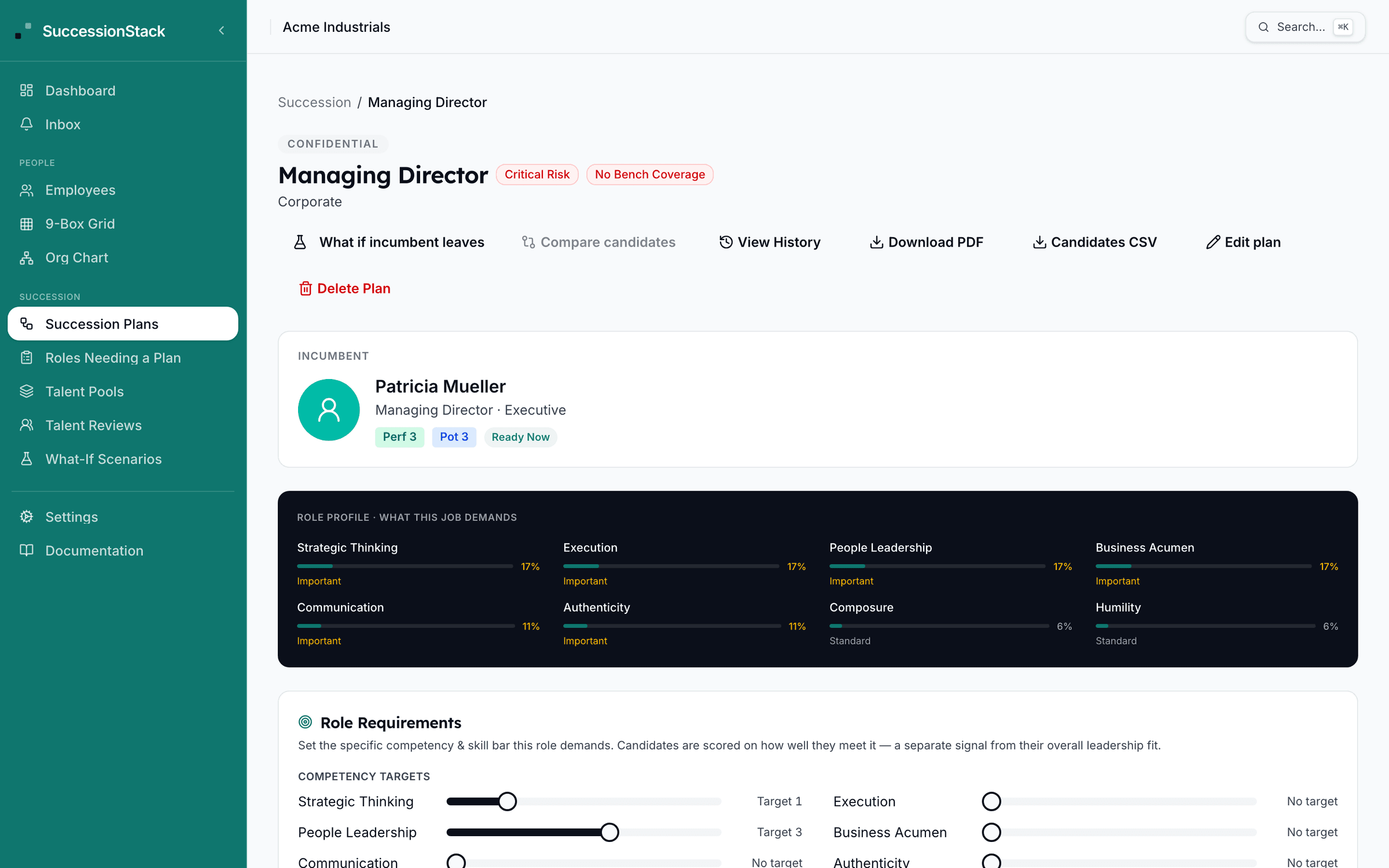
Candidates on an executive plan carry scores across eight weighted leadership dimensions, and the weights are adjustable per role, because what the COO seat demands is not what the CHRO seat demands. Every score, weight change, and readiness call lands in an append-only audit log with the actor and the reason. When the committee asks why the bench moved, the answer is on record.
Four moments that expose a thin executive bench
Executive succession gets tested on someone else's schedule. These are the moments where a plan either answers or apologizes.
The committee asks for the CFO bench
A director wants names, readiness, and the development plan behind each name. A deck from last March invites more questions than it settles. Scored candidates with dated evidence and readiness windows close the loop in a single review.
Due diligence asks about continuity
An acquirer or lender wants to know what happens if the CEO or COO leaves mid-deal. A written, current plan with named cover is a different negotiating position than a verbal assurance from the same executives being asked about.
One resignation exposes three plans
The VP everyone counted on was quietly the successor for three separate seats. What-if modeling with cascade analysis up to three levels deep shows the overlap before the resignation letter does.
The plan's author leaves
The CHRO who built the plan departs and takes the reasoning along. When scores, weights, and changes are logged with actor and reason, the next owner inherits a record instead of a rumor.
An executive succession plan is a governance document. It should survive the departure of the person who wrote it.
- 8weighted leadership dimensions behind every candidate
- 100%of scoring and plan changes recorded with actor and reason
- 3readiness windows mapped across every executive bench
How do you move executive succession off a guarded spreadsheet?
Executive plans are small in headcount and heavy in scrutiny, which makes them fast to stand up. Most teams are live in one to two weeks.
Load the top tiers
Import executives and their direct reports from CSV. The plan population at this level is usually under a hundred people, so the import is an afternoon, not a project.
Weight the dimensions per seat
Set what each role actually requires across the eight dimensions. Every adjustment is logged with its author and reason, so the criteria are as defensible as the scores.
Score and map the bench
Assess candidates against the weighted criteria, then map each seat's bench across Ready Now, one year, and two to three years.
Stress-test and export
Run what-if departures on the seats that worry the board, then export the PDF packet the committee will actually read.
Questions buyers actually ask
See where your bench breaks before it matters.
Bring your real org chart. We show you the succession gaps, cascade risks, and bench depth in a 30-minute walkthrough. IT security questions answered on the same call.
IT review first? The FAQs answer the security questions honestly →