The first 48 hours, decided in advance.
What is an emergency succession plan?
An emergency succession plan answers a narrower question than a long-term one: not who should eventually hold this role, but who holds it tomorrow morning if the incumbent is suddenly unavailable. The interim named in an emergency plan is often not the permanent successor, and should not have to be. Conflating the two produces plans that stall, because naming someone as the heir feels weighty, while naming them as ninety-day cover is just operations.
The working standard is one page per critical role. The page names the interim, spells out the authority they carry from day one (spending limits, signing rights, what they can approve and what they can stop), lists who gets notified in what order, and notes the two or three things about the role that only the incumbent knew. If the page takes longer than a minute to find or ten minutes to act on, it fails at the only moment it exists for.
Emergency and long-term plans are one system seen at two time scales. Interim names come from the same scored bench as permanent candidates, and every gap the emergency exercise exposes, whether a role with no plausible cover or a successor backstopping three seats, becomes a development priority in the long-term plan. Organizations that keep the two disconnected end up staffing crises from memory anyway.
Rehearse the departure before it happens.
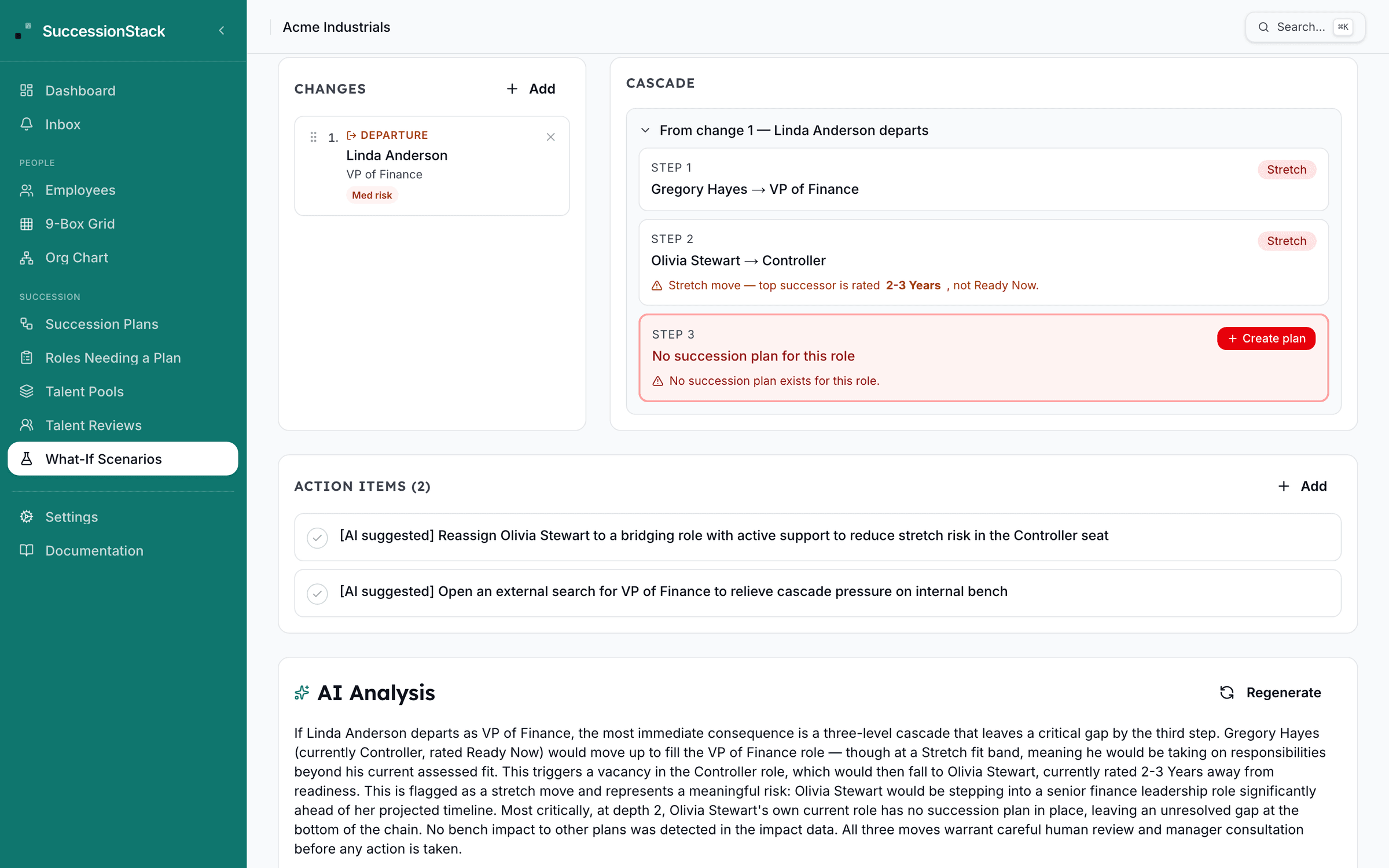
SuccessionStack's what-if modeling removes a leader on screen and shows the consequences: which plans are exposed, where the interim comes from, and what the backfill opens up behind it, with cascade analysis up to three levels deep. The AI narrates each scenario in plain English, so the emergency plan for a role reflects the actual chain of holes a departure would create, not just the first one.
The first 48 hours, gone wrong four ways
Post-mortems of bad transitions rarely find a missing genius. They find missing pages: small operational answers nobody wrote down while there was time.
Nobody can sign
Payroll approvals, vendor payments, and a contract deadline all routed through the person who just left, and no one else holds the authority. An emergency page that transfers explicit authority on day one keeps the machinery running.
The interim finds out from the announcement
The named cover was never told, never prepared, and starts the hardest week of her career flat-footed. A plan the interim has read and accepted is a different instrument from a plan about them.
The plan is wherever he kept it
The departed executive was also the plan's owner and its archive. Plans held in one governed system, exportable to PDF for the response team, survive the departure of their author.
The backfill opens the second hole
Moving the strongest director up to cover a VP exit guts the team that director ran, and nobody modeled it. Cascade analysis three levels deep shows the whole chain before anyone pulls it.
An emergency plan you have to search for is not a plan. It is a document someone once wrote.
- 3levels deep on every what-if departure cascade
- 100%of plan changes logged, so cover stays current and provable
- 1–2weeks from CSV to emergency cover for every critical role
How do you set up emergency cover for a critical role?
This is deliberately a short project. Emergency cover does not need perfect answers; it needs written ones, revisited on a schedule.
List the roles that stop work
Not the org chart's top tier by default: the roles where a two-week vacancy freezes payments, shipments, or decisions. Include the quiet single points of failure.
Name the interim and the authority
One person per role, with day-one authority spelled out, and confirmation that they know and accept the assignment.
Stress-test each departure
Run the what-if scenario, read the cascade, and fix the plans where the interim's move would open a worse hole than the one it fills.
Put the page where the crisis can find it
Export each role's plan to PDF for the people who respond at 7 a.m., and keep the live version current in the system.
Review quarterly, feed the gaps forward
Names go stale as people move. Re-check cover every quarter, and turn every exposed gap into a development action in the long-term plan.
Questions buyers actually ask
See where your bench breaks before it matters.
Bring your real org chart. We show you the succession gaps, cascade risks, and bench depth in a 30-minute walkthrough. IT security questions answered on the same call.
IT review first? The FAQs answer the security questions honestly →