Succession planning software that shows its work.
Why dedicated software, and why now?
The numbers on this problem are grim and well documented. In DDI's Global Leadership Forecast 2025, only 20% of HR leaders said they have people ready now for their most critical roles, and internal candidates could immediately fill just 49% of critical positions. A SHRM survey found barely one in five organizations has a formal succession plan at all; more than half have none. And research published in Harvard Business Review put the cost of badly managed CEO and C-suite transitions at close to a trillion dollars a year in the S&P 1500 alone.
None of that is a software problem by itself. It becomes one when the plan lives in a spreadsheet: scores with no evidence, readiness calls nobody remembers making, a document rebuilt from scratch before every board meeting. The plan decays faster than it gets corrected, leaders quietly stop consulting it, and the next departure gets handled from memory, exactly as if the plan never existed.
Succession planning software exists to hold the process still: criteria that stay put, scores with provenance, readiness windows someone would act on, and a bench you can interrogate the day a resignation lands.
Your whole bench, one honest view.
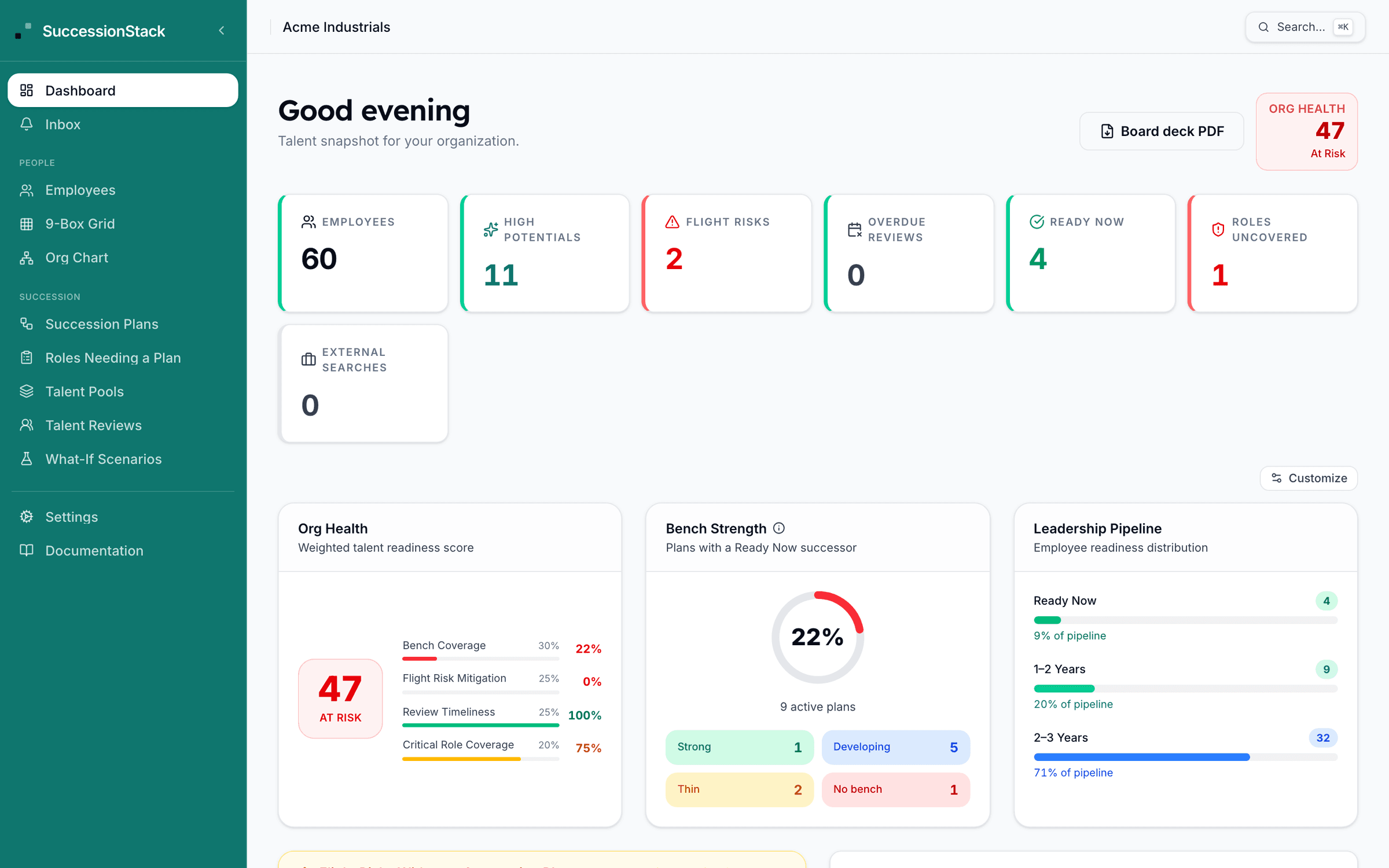
The dashboard answers the question boards actually ask: where is cover real, where is it thin, and which way is it trending? Bench depth by readiness window, plans that need attention, and the roles where a single departure would cascade. No assembly required the night before the meeting.
What the tool has to do that a spreadsheet can't
These four capabilities are the difference between software and a nicer grid. They are also the four places where spreadsheet plans go to die.
Scoring with provenance
Eight weighted leadership dimensions per candidate, weights tunable per role, and every score or weight change logged with actor, date, and reason. When a readiness call is challenged, the plan answers instead of apologizing.
A bench in readiness windows
Ready Now, 1 year, 2–3 years, per plan and across the org. The difference between a name and a pipeline is knowing when each name becomes real.
What-if cascade modeling
Model a departure up to three levels deep, watch which plans go thin, and read an AI-narrated summary of the impact. Departures chain; single-role planning can't see the chain.
Board-ready evidence
PDF exports and an append-only audit log mean the succession review runs on the same numbers HR maintains all year, with the history attached.
Every plan carries its own evidence.
Open any role's plan: scored candidates, their readiness windows, the gaps development is closing, and who changed what along the way. This is the page that turns 'trust me' into 'see for yourself', for the board, the skipped-over candidate, and the auditor alike.
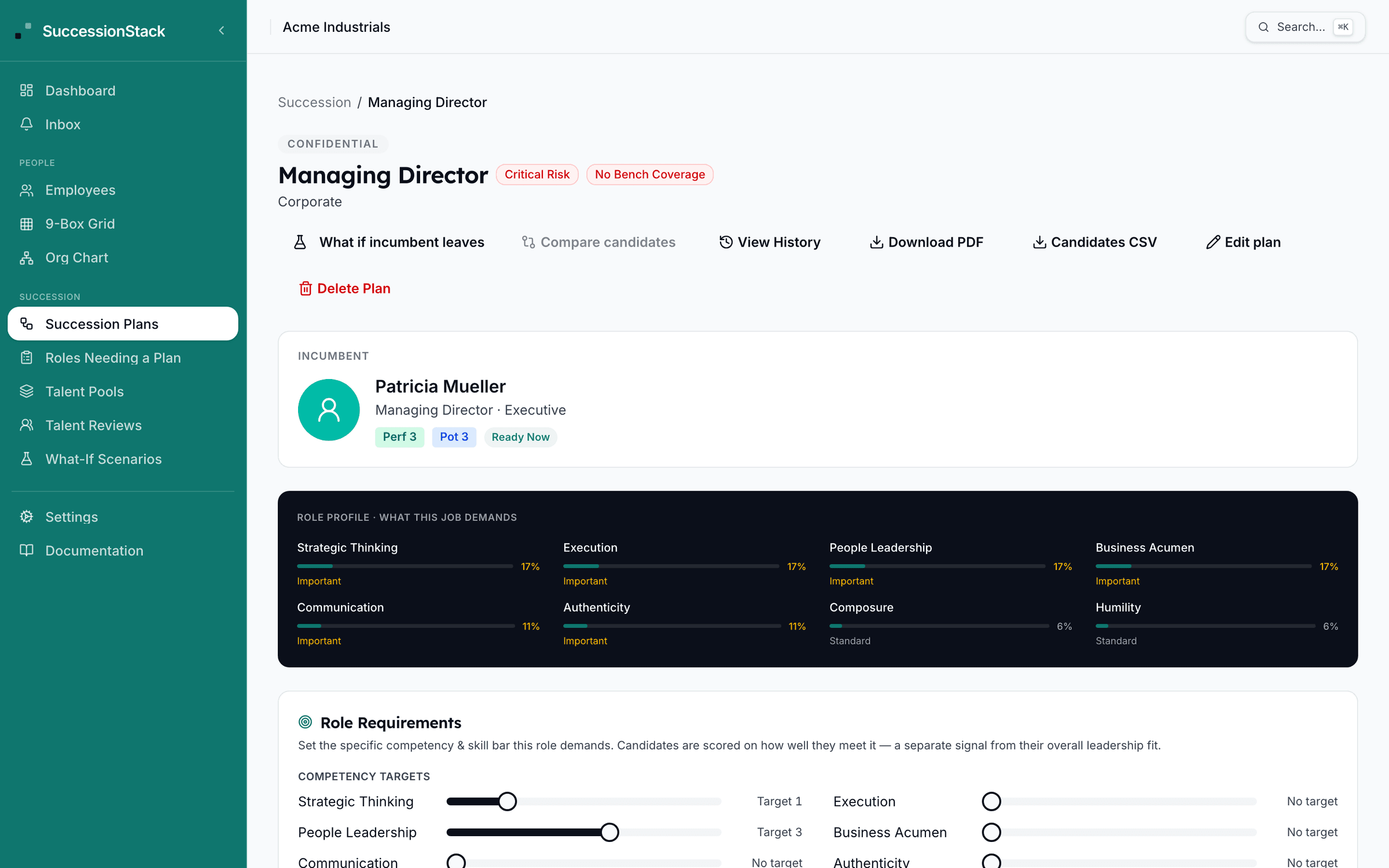
A succession plan is a set of claims about people. Software's job is to make every claim carry its evidence.
- 8weighted leadership dimensions behind every score
- 3levels deep on what-if cascade modeling
- 1–2weeks from CSV export to a usable bench view
Built for the succession problem you actually have
The same scoring model and bench underneath; a different front door per problem.
Executive Succession Planning Software
Executive succession planning software for C-suite and VP benches: scored candidates, readiness windows, and an audit trail that stands up to the board.
CEO Succession Planning: Process, Software & Checklist
A practical CEO succession planning guide: who owns it, emergency vs planned transitions, a working checklist, and software that keeps the plan current.
Leadership Succession Planning Software
Leadership succession planning software for the director and VP tiers: scored pipelines, calibrated reviews, and development that moves readiness forward.
Talent Succession Planning Software
Talent succession planning software connecting the whole workforce to real plans: one talent database, pools alongside named benches, decisions from reviews.
9-Box Grid Software for Talent Reviews
9-box grid software that keeps the debate and drops the spreadsheet: plot performance against potential, calibrate with evidence, feed placements into plans.
Board Succession Planning Software
Board succession planning software for director refreshment, committee continuity, and board oversight of executive succession, with a full change history.
Emergency Succession Planning Software
Emergency succession planning software: one page per critical role, named interim authority, and what-if cascade stress tests for the first 48 hours.
Small Business Succession Planning
Succession planning for small and growing businesses: name the roles you cannot afford to lose, find real successors, and keep a current bench.
Auditable Succession Planning Software
Every score and weight change logged with who changed it, when, and why. Auditable succession planning built for mid-market HR, not enterprise suites.
Succession Management Software
Succession management is keeping succession plans true between reviews: scored readiness, logged changes, and a bench that stays current.
Business Succession Planning
Business succession planning is two handoffs, not one: ownership and leadership. We handle the leadership half: who can run the company, and how ready they are.
Succession Planning Services vs Software
When you need succession consultants, when software is enough, and when you need both. An honest breakdown from a company that sells only the software half.
Or start from your industry
A focused succession planning tool, or your suite's module?
Honest answer: it depends on what is actually broken. If your organization already runs a full HCM platform, uses its succession module, and the module gets opened more than twice a year, keep it. Zero procurement beats a better tool that has to clear a vendor review.
The teams that come to us have a different situation: the suite module exists but nobody uses it, because it is a form inside a system built for payroll and reviews; or there is no suite at all and succession lives in a spreadsheet with eight editors and no memory. For them, a dedicated succession planning tool that is live in two weeks, prices per tenant instead of per seat, and treats auditability as the core feature is the difference between having a plan and having a file.
We keep the comparisons honest, including where the suites win: see the head-to-head comparisons or the guide to succession module alternatives.
Questions buyers actually ask
See where your bench breaks before it matters.
Bring your real org chart. We show you the succession gaps, cascade risks, and bench depth in a 30-minute walkthrough. IT security questions answered on the same call.
IT review first? The FAQs answer the security questions honestly →