Small business succession planning
Succession planning for small and growing teams.
Why do small businesses skip succession planning?
Most small businesses do not skip succession planning on purpose. They skip it because it feels like an enterprise concern, something you get to after you are big enough to have an HR department and a board asking questions. The result is a specific and common exposure: a company of eighty or two hundred people whose entire continuity plan lives in the founder's head and a few key managers nobody has a backup for.
The irony is that key-person risk is often sharper in a small company, not softer. In a 5,000-person org, losing a director is a problem; in an 80-person org, losing the one person who understands the billing system, holds the top client relationships, or runs operations can stall the whole business. Fewer people means every person carries more, which means every departure removes more.
Surveys consistently find that a majority of small and mid-sized businesses have no formal succession plan at all. That is not negligence so much as triage: succession loses every week to the more urgent fire. The fix is not a big program. It is a small, honest one that fits the size of the company.
Start with the handful of roles that would actually hurt.
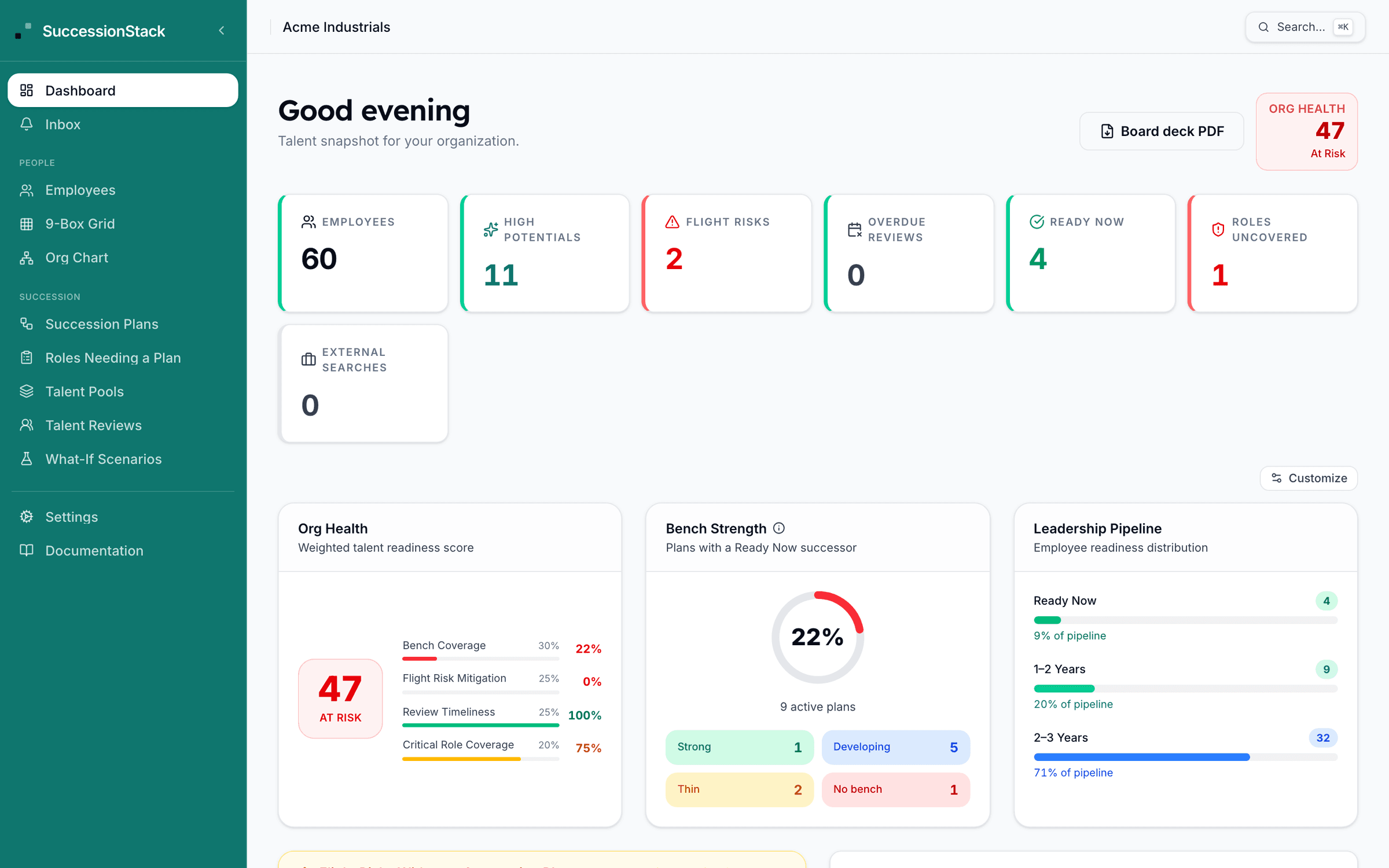
A small company does not need to plan the whole org chart. It needs to name the five or ten roles where a sudden absence would stop revenue, break a key relationship, or halt operations, and get a real successor conversation going for each. SuccessionStack maps those roles by readiness so you can see, at a glance, where you have cover and where one resignation would leave a hole.
Where small companies get caught
The failure modes are the same as the enterprise ones, minus the safety net. A small team has less slack to absorb a surprise departure, so the exposure shows up faster and hurts more.
The founder who is the plan
In many small companies the succession plan is the founder's memory. It works until the founder is unavailable for a week, and then nobody can find the plan because it was never written down.
The irreplaceable operator
One person runs finance, or fulfillment, or the biggest account, with no backup and no documentation. Their two-week notice becomes a two-quarter scramble.
The promotion with no backfill
A strong manager finally moves up, and their old job has no one behind it. In a small team that gap is felt in the next week, not the next planning cycle.
The plan that never gets updated
The rare small company that does write a plan usually writes it once. A year later it lists people who left and misses people who joined, and quietly stops being consulted.
A small business does not need a big succession program. It needs the five roles it cannot afford to lose written down, with a real answer for each.
- 5–10critical roles most small companies actually need to plan
- 1CSV import to a live bench, no consultant required
- 1–2weeks from import to a working plan
How do you start succession planning in a small company?
The whole thing fits in an afternoon of decisions and a few weeks of follow-through.
List the roles you cannot afford to lose
Not titles, consequences. Which five or ten people, gone tomorrow, would stop revenue, break a client relationship, or halt operations? Those are your critical roles, and there are fewer of them than the org chart suggests.
Name a real successor, or admit there is none
For each role, name who could step in and how ready they honestly are. A role with nobody behind it is not a failure to hide; it is the most important thing the exercise found.
Write down what only they know
Key-person risk in a small company is often knowledge, not authority. Capture the relationships, systems, and context that would leave with the person, so a successor is not starting blind.
Keep it current with the business
Revisit the list when someone joins, leaves, or gets promoted. In a small company that is a quick conversation, and doing it is what keeps the plan from decaying into fiction.
Questions buyers actually ask
See where your bench breaks before it matters.
Bring your real org chart. We show you the succession gaps, cascade risks, and bench depth in a 30-minute walkthrough. IT security questions answered on the same call.
IT review first? The FAQs answer the security questions honestly →