Leadership succession, built where the volume lives.
Why does succession planning stall below the executive team?
The attention gradient in most companies is steep: the CEO succession file gets board time, the executive bench gets an annual review, and the dozens of director roles below them get whatever is left. Yet the middle tiers are where succession actually operates. Nearly every credible executive candidate spends years as a director or VP first, so a thin pipeline at those levels becomes a thin executive bench on a three-year delay.
The middle also breaks tooling first. Five executive plans survive in a spreadsheet through sheer force of attention. Forty director plans do not: scores go stale, one department rates generously while another rates hard, and the file forks into versions nobody reconciles. The volume that makes the leadership tier matter is the same volume that makes informal methods collapse under it.
A leadership pipeline is a development engine or it is nothing. Naming successors costs an afternoon; moving someone from a two-year window to Ready Now takes assignments chosen against specific scored gaps, checked on a cadence, with the history kept. The named list is the byproduct. The development underneath it is the plan.
Scoring reviews that scale past the top team.
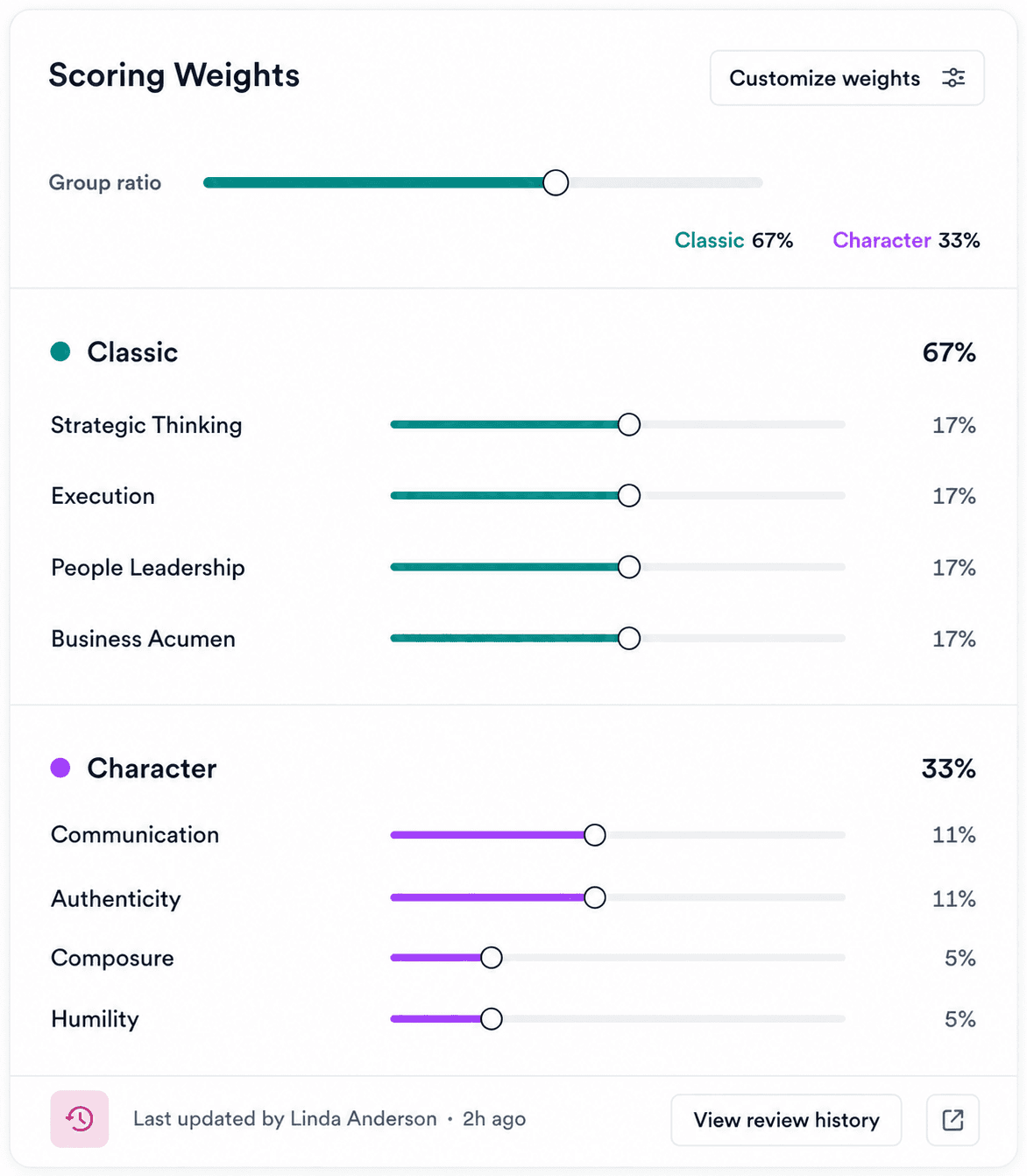
Every leader is scored on eight weighted leadership dimensions, with weights adjustable per role, because a plant director and a product director should not be measured on an identical mix. Reviews carry evidence and dates, changes are logged with actor and reason, and the same scores feed the grid, the bench views, and the plans, so forty director assessments stay one consistent record instead of forty opinions.
Where director-level pipelines leak
Pipeline failures in the middle tiers are quiet. Nobody convenes a board meeting when a director role turns over badly; the cost just shows up as a long external search and a team treading water.
The promotion that empties a team
A director finally makes VP, and the celebration lasts until someone asks who runs her old team. Bench mapping across readiness windows makes the second question part of the first decision.
The high potential nobody told
A strong senior manager appears in zero plans, draws no development, reads the silence as a ceiling, and resigns. Pipelines that only look upward miss the people who would have filled them.
Ratings that drift by department
Engineering scores harshly, sales scores generously, and cross-department comparisons quietly become fiction. Shared dimensions with calibrated reviews put every leader on one scale.
Development actions without dates
'Needs more strategic exposure' sits unchanged in the file for two years. Actions tied to scored gaps, with owners and a review cadence, either move or become visibly stuck.
Executive succession is decided in the boardroom, but it is built two levels down, years earlier.
- 8weighted dimensions scoring every leader on one scale
- 3readiness windows turning name lists into a pipeline
- 1–2weeks from CSV import to a working pipeline
How do you build a leadership pipeline below the executive team?
The work repeats down the org in the same four moves; only the headcount changes.
Import every leader, not just executives
One CSV brings in directors, VPs, and the senior managers behind them. The talent database is live the same day, alongside your HRIS rather than in place of it.
Mark the roles that must not go dark
Not every director seat needs a plan. Pick the ones where a vacancy stops revenue, shipments, or compliance work, and plan those first.
Score, calibrate, repeat on a cadence
Run scoring reviews against the eight dimensions and let calibration surface the departments drifting off-scale before the drift compounds.
Attach development to every window
Each candidate short of Ready Now gets actions tied to specific scored gaps, reviewed quarterly rather than remembered annually.
Questions buyers actually ask
See where your bench breaks before it matters.
Bring your real org chart. We show you the succession gaps, cascade risks, and bench depth in a 30-minute walkthrough. IT security questions answered on the same call.
IT review first? The FAQs answer the security questions honestly →