Healthcare
Continuity planning for organizations that can't pause for a vacancy.
Why succession planning is different in healthcare
Healthcare leadership pipelines carry constraints most industries never see. Clinical leadership roles (CMO, CNO, service-line chiefs) require licensure, board certification, and credentialing timelines that can stretch a transition by months even when the successor is already chosen. An external search for a hospital CEO routinely runs half a year or longer, and the interim period lands on an executive team already stretched by the operational tempo of patient care.
The dual-ladder problem compounds it. Health systems run two leadership tracks, clinical and administrative, and the strongest candidates for senior operational roles often sit on the clinical ladder with no structured path across. A succession plan that only maps the administrative org chart misses half the bench, and the half it misses is the harder one to replace.
Then there is the turnover itself: hospital CEO transitions have run at elevated rates for years, and departures cascade through executive teams as new leaders rebuild their cabinets. Planning for one vacancy at a time understates the real exposure, which is why cascade modeling matters more in healthcare than almost anywhere else.
The roles healthcare plans have to cover
Criticality in a health system does not follow the org chart. These are the seats where a vacancy costs the most, and where a bench takes the longest to build.
Hospital and regional CEOs
Extended searches, board involvement, and community visibility make CEO transitions the most expensive kind. An internal Ready Now candidate changes the timeline from months to weeks.
CNO and nursing leadership
Nursing leadership carries licensure requirements, workforce-stability stakes, and regulatory exposure at once. Bench depth here is a patient-care continuity issue, not just an HR metric.
Service-line and medical directors
Physician leaders who carry both clinical credibility and P&L responsibility are the hardest dual profile to source externally. Growing them internally is the only reliable supply.
Revenue-cycle and compliance leads
Below the executive tier, a handful of specialists hold the institution's billing integrity and survey readiness in their heads. Classic key-person risk, rarely on anyone's succession list.
See the whole bench, both ladders.
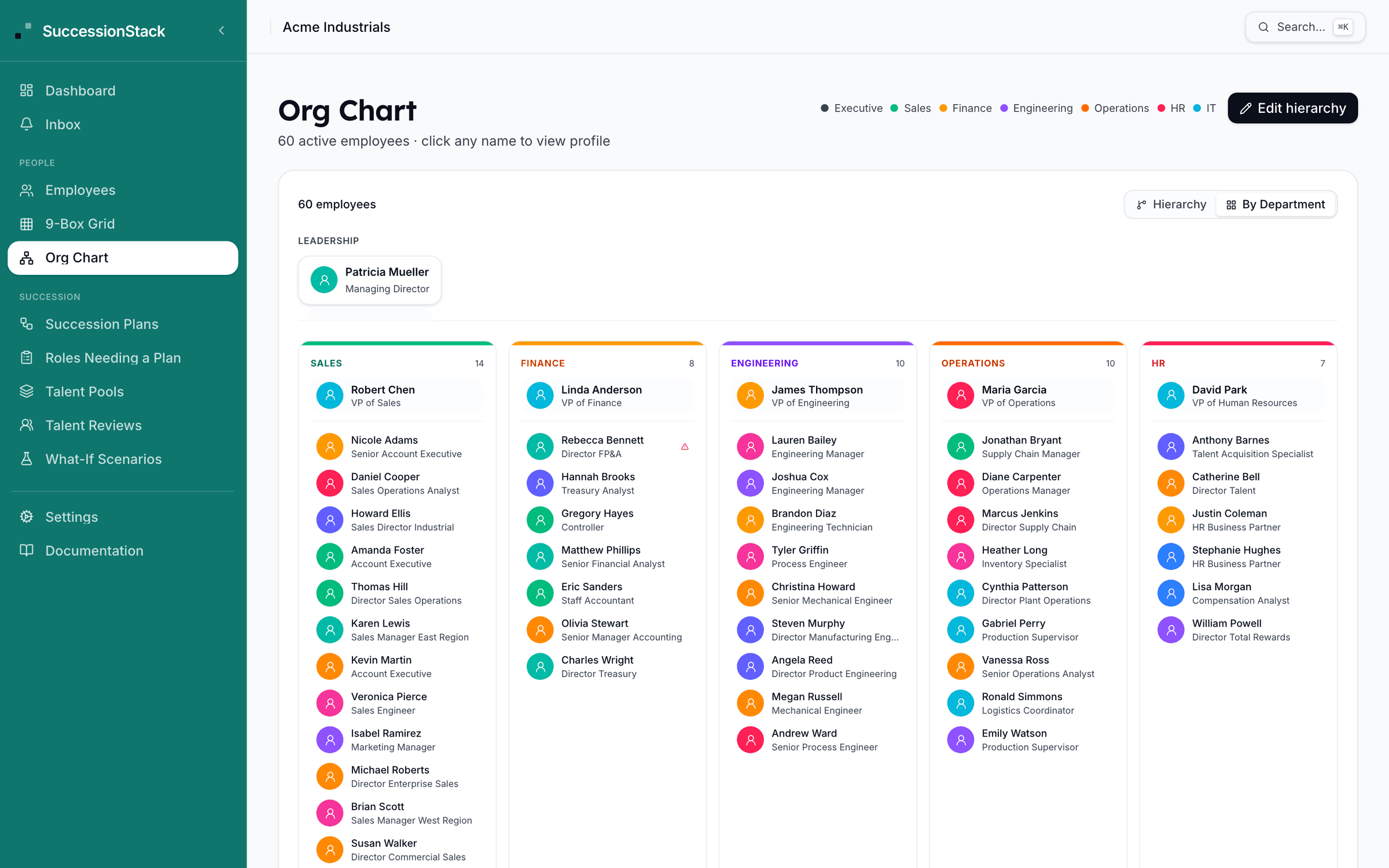
SuccessionStack maps clinical and administrative leadership in one view: every candidate scored on eight weighted dimensions, readiness tracked across three windows, and the credentialing-length lead times visible in the plan instead of discovered during the transition. When a departure hits, the what-if model shows the cascade across both ladders before the board asks.
How health systems get live
Built for HR teams that do not have implementation capacity to spare.
Import from your HRIS export
CSV from Workday, UKG, or whatever runs payroll today. Leadership structure live the same week.
Flag the critical seats
Mark clinical and administrative roles by cost of vacancy, including the sub-executive specialists.
Score and calibrate
Eight dimensions, weights tuned per role: what a CNO needs is not what a regional CFO needs.
Stress-test the cascades
Model the CEO departure before the board asks. See which plans go thin and fix them in daylight.
Questions buyers actually ask
See where your bench breaks before it matters.
Bring your real org chart. We show you the succession gaps, cascade risks, and bench depth in a 30-minute walkthrough. IT security questions answered on the same call.
IT review first? The FAQs answer the security questions honestly →