Succession that sees the whole workforce.
What is talent succession planning?
Talent succession planning widens the lens from a short list of named plans to the whole workforce. Classic succession planning starts with a role and asks who could fill it. Talent succession planning also runs the opposite direction: it starts with the people, keeps a current record of what each one can do, and asks which of them could grow toward the roles that will matter. Both directions are necessary; either one alone leaves blind spots.
The working distinction is pools versus named plans. A named plan attaches specific candidates to a specific seat, with readiness windows and development actions. A talent pool gathers people with leadership or specialist potential before there is a seat to name them against, so development starts years ahead of the vacancy. Companies that only run named plans keep rediscovering the same eight usual suspects; pools are where the ninth name comes from.
Talent reviews are the mechanism that connects the two. A review that ends as a slide deck changed nothing. A review whose placements flow into pools and named benches, with the scores and the debate preserved, compounds: each cycle starts from the last one's decisions, and the gap between 'we discussed her' and 'she is on the plan' disappears.
One talent database underneath everything.
Every plan, grid, and pool in SuccessionStack draws from a single talent database. People come in by CSV and go out by CSV or PDF when a committee wants a packet. Profiles carry scores on eight weighted dimensions with their full history, so the record that supports a talent review is the same record that supports the succession plan, with no reconciliation step in between.
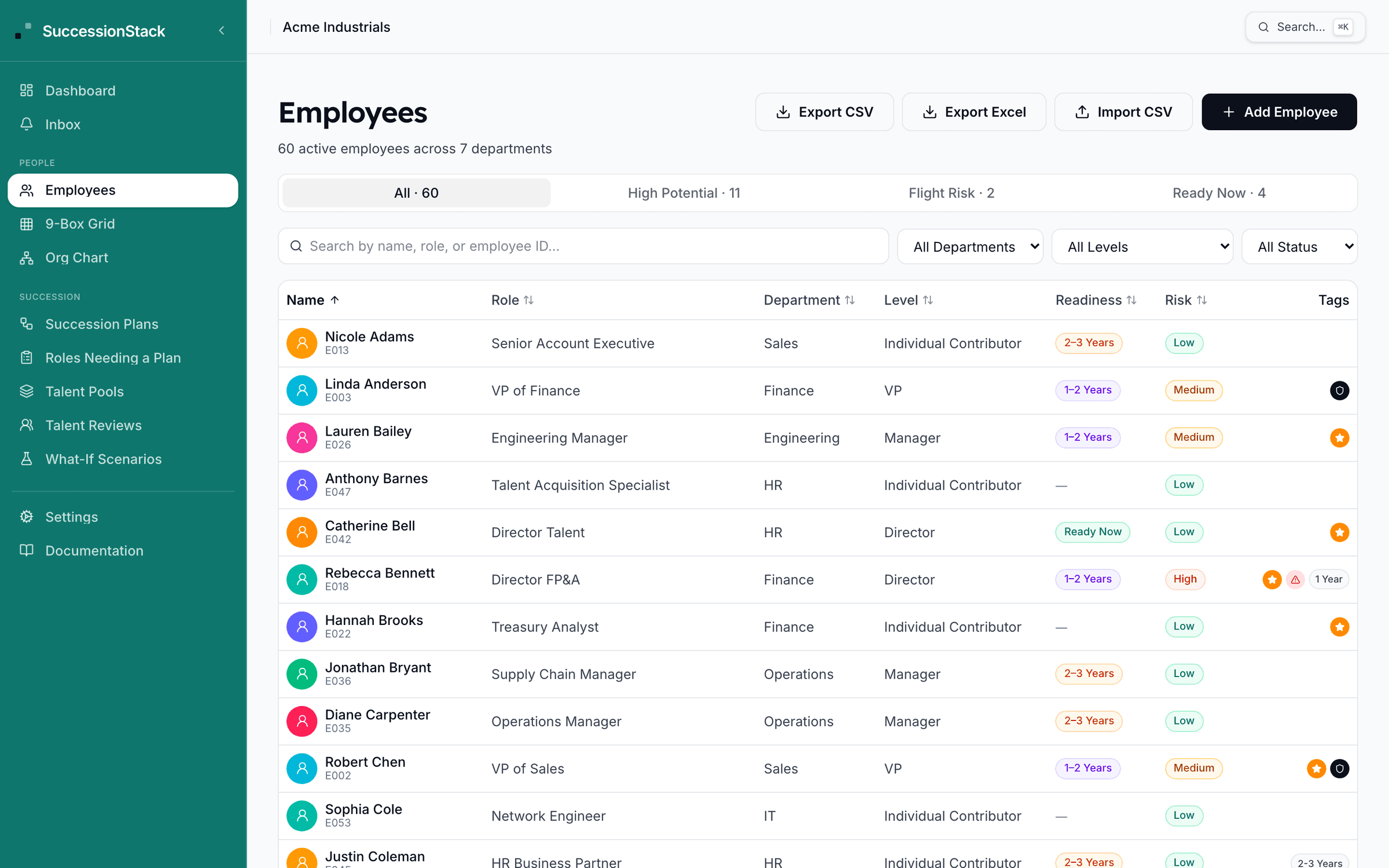
Four gaps between talent reviews and succession decisions
Most organizations do not lack talent processes; they lack the connections between them. These are the four places where the thread usually snaps.
The review that ends as a deck
Two days of calibration produce placements, the placements produce slides, and the slides produce nothing. When the grid and the plans share one data model, a placement is one step from a bench.
The same eight names in every pool
Visibility runs on familiarity, so the well-known few appear everywhere while equal talent two levels down stays invisible. A scored, searchable database widens the pool past the people leadership already knows.
Three spreadsheets that disagree
The HRIS export, the review file, and last year's plan each tell a different story about the same person. One record with an audit history replaces the reconciliation meeting.
Development that resets on transfer
A candidate moves business units and arrives as a blank slate, because her scores and development history lived in the old team's files. A workforce-level record follows the person, not the org box.
A succession plan is only as good as the talent record underneath it.
- 8weighted dimensions on every profile in the database
- 3readiness windows connecting pools to named benches
- Per-tenantpricing, so covering the whole workforce adds no per-seat cost
How do you go from a CSV to a working talent system?
The path from raw roster to working system is short, because SuccessionStack runs alongside your HRIS instead of replacing it.
Import the workforce
One CSV loads the roster, and the org chart assembles itself into hierarchy and department views from the same file.
Build pools and name the benches
Stand up pools for broad potential and named plans for the roles where a vacancy would hurt this quarter.
Run reviews that write back
Score leaders on the eight dimensions and let review placements update pools and benches directly, instead of ending their lives in a deck.
Report in the format the room wants
Bench strength, org health, and pipeline analytics on screen; CSV and PDF exports when the packet needs to travel.
Questions buyers actually ask
See where your bench breaks before it matters.
Bring your real org chart. We show you the succession gaps, cascade risks, and bench depth in a 30-minute walkthrough. IT security questions answered on the same call.
IT review first? The FAQs answer the security questions honestly →