Nonprofits
A succession plan your board approves and your funders can ask about.
Why succession planning is different for nonprofits
In most nonprofits, leadership risk concentrates in one seat to a degree the corporate world rarely sees. The executive director holds the program vision, the major-donor relationships, the board's trust, and often the founding story itself. Founder transitions in particular have a long record of going badly: the departure gets deferred for years, the board underestimates the search, and the successor inherits a role shaped entirely around one person. None of that improves with time. It improves with a written plan, honest readiness assessments, and a runway measured in years rather than a board meeting called after the resignation letter arrives. Interim executive directors buy time, but they cost momentum with funders and staff, and boards routinely underestimate both.
Boards and funders have noticed. Succession policies now show up as standard governance hygiene: grant applications ask about them, institutional funders raise them in due diligence, and board self-assessments include them. The uncomfortable part is that a policy document in a shared drive satisfies the letter of the question and none of its substance. What a funder is actually asking is whether the organization survives a leadership transition without the mission stalling. Answering that takes a living plan: named coverage for an emergency, successors developing on honest timelines, and a record showing the plan gets reviewed rather than filed. A plan with named coverage also changes the grant conversation, because continuity risk is one of the few objections a small organization can fully retire.
Structure works against nonprofits here. Leadership layers are thin, deputy roles are rare, and program directors already carry two jobs each. The development director's funder relationships are personal in a way that makes the role a classic key-person risk: when they leave, the pipeline of asks leaves with them. And the volunteer board that owns succession turns over on its own cycle, so the trustee who championed the plan rotates off and the institutional memory of the plan itself disappears. The fix is a system of record that outlives any individual board term, with a history of what was decided and why.
The roles nonprofit plans have to cover
A nonprofit's critical seats are few, which is exactly why each one carries so much of the mission.
Executive director
Both transitions matter: the planned one, with a multi-year development runway, and the emergency one, where the board needs a named interim and a written protocol before the crisis rather than during it. Readiness windows give the board a truthful timeline instead of an optimistic one.
Development director
Fundraising relationships live with the person, not the title. A departure mid-campaign can cost a year of pipeline, which makes this seat a succession priority even in small organizations. Mapping which relationships are transferable, and to whom, is succession work as surely as any org chart exercise.
Program directors
They carry service delivery, grant compliance, and staff leadership at once, usually with no deputy beneath them. The bench for these roles has to be built deliberately, because it does not exist by accident. A 2 to 3 year window with a real development plan is achievable for most program teams that start early.
Finance lead
One person often holds restricted-fund accounting, audit preparation, and grant reporting. Funders notice a gap here fast, and interim coverage is expensive and slow to source. Emergency coverage here can be as simple as a named external firm, provided it is named before the vacancy.
The plan your governance committee asks to see.
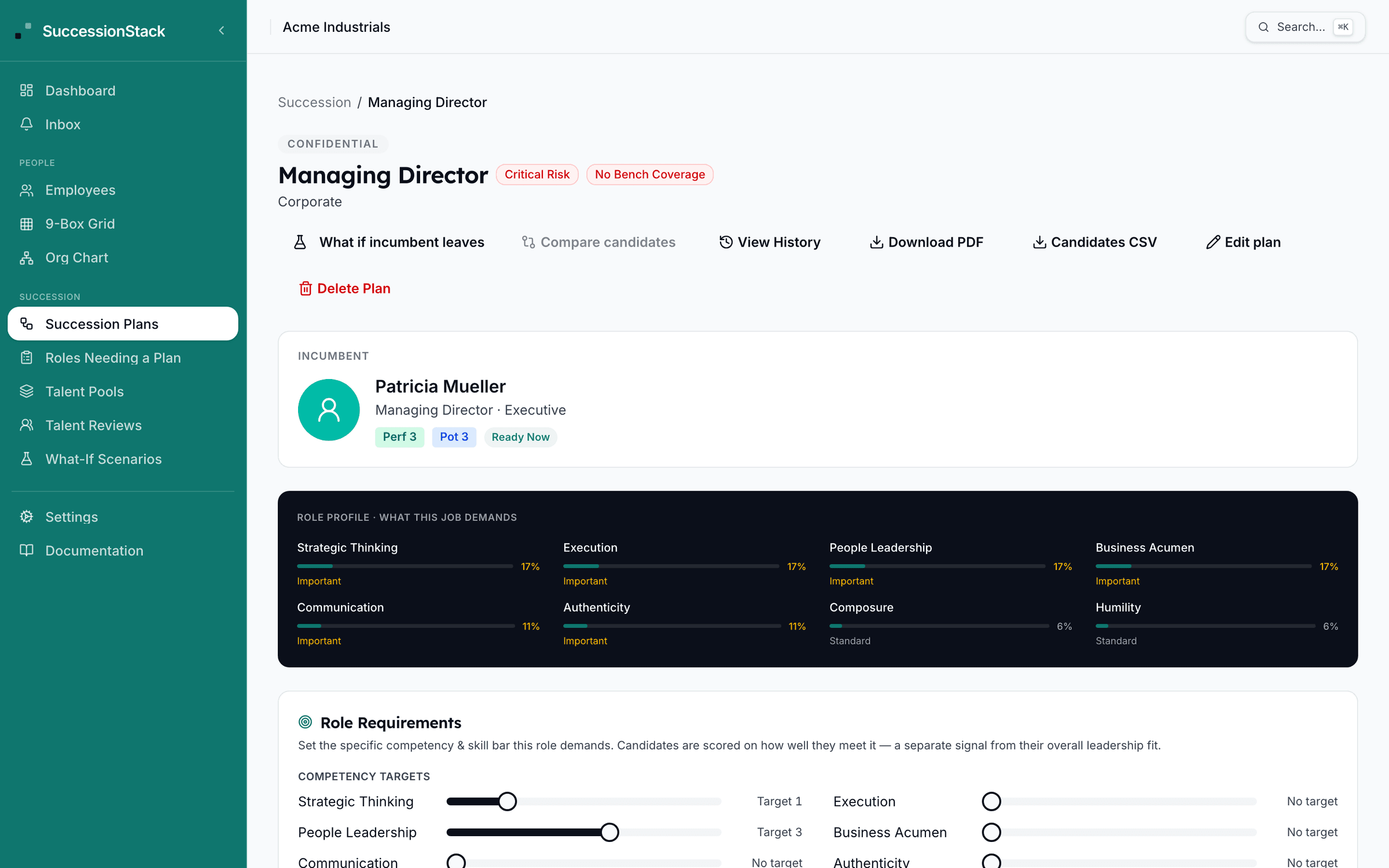
Each critical role gets a real plan: successors mapped across Ready Now, 1 year, and 2 to 3 year windows, scored on eight weighted dimensions, with emergency coverage named. Every change is recorded in an append-only audit log, so when a funder or a new board chair asks whether the plan is current, the history answers for itself. That is the difference between a succession policy and a succession practice. CSV import and export keep the roster current without new data entry, and the same plan view serves the board packet and the annual funder conversation.
How nonprofits get live
Sized for teams where HR is one person, or part of one person.
Import your staff roster
A CSV from your payroll system, or a spreadsheet, works. Most organizations are live inside two weeks.
Start with the seats the mission cannot lose
The executive director, the development lead, and the two or three roles where a vacancy stops programs. Depth comes later.
Score candidates and name emergency coverage
Eight dimensions with weights set per role, plus a named interim for the ED seat so the emergency protocol is real.
Put it in front of the board
The governance committee reviews the plan on a cadence, and the audit log shows it has been maintained between meetings.
Questions buyers actually ask
See where your bench breaks before it matters.
Bring your real org chart. We show you the succession gaps, cascade risks, and bench depth in a 30-minute walkthrough. IT security questions answered on the same call.
IT review first? The FAQs answer the security questions honestly →