Government & Public Sector
Deeper pools for the merit system to choose from.
Why succession planning is different in government
Retirement eligibility is the public sector's quiet exposure. Long tenures mean senior civil servants reach eligibility in waves, and eligibility is not a departure date: it is an option the employee holds, exercisable on short notice. So agencies carry a workforce where a meaningful share of senior leadership could leave within a year, with institutional knowledge to match the tenure. The program administrator who remembers why the rule was written, which consent decree shaped the process, and how the last three directors handled the legislature is not replaceable through a job posting. That knowledge transfers through deliberate overlap, and overlap requires knowing the exposure in advance.
Merit-system rules constrain what succession planning is allowed to mean, and any vendor who glosses over that is selling you a grievance. Public agencies cannot pre-select successors or promise positions; competitive processes decide who gets the job. What agencies can lawfully do, and what public workforce-planning guidance has long encouraged, is identify critical positions, define the competencies they require, and develop pools of employees who will be qualified to compete when vacancies post. SuccessionStack is built to support exactly that framing: it tracks pool depth and readiness against critical roles, and nothing in it appoints anyone to anything.
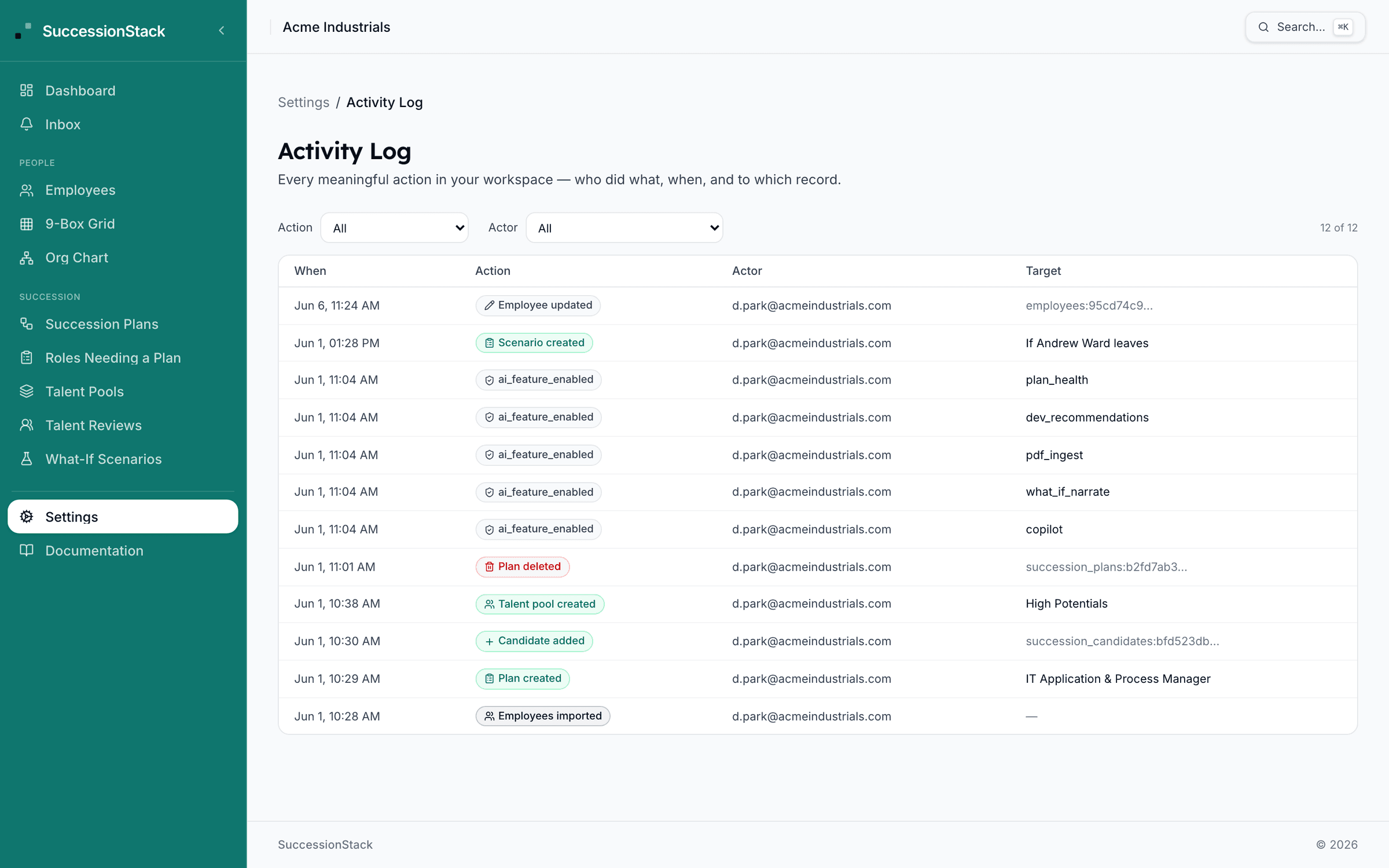
Public accountability changes the tooling requirements too. A defensible process needs a record: what was assessed, against which criteria, by whom, and when. SuccessionStack's append-only audit log holds that history without anyone maintaining it by hand. Procurement realities matter as well. Pricing is per-tenant rather than per-seat, which keeps the purchase simple to budget and stops headcount math from distorting the decision, and standing up from a CSV in one to two weeks fits inside a fiscal-year window instead of spanning two of them.
The positions public-sector plans have to cover
Criticality in government follows statute, licensure, and institutional memory more than the org chart's top box.
Career deputies and agency leadership
Appointed leaders come and go with administrations; career deputies carry the agency across transitions. Pool depth behind these positions is continuity of government in miniature.
Program managers with statutory expertise
The person who knows the grant regulations, the audit history, and the reasons behind the process is often one deep. When they retire, the agency relearns that knowledge the expensive way.
Public works and engineering leadership
Licensure requirements meet an aging technical workforce. Developing licensed successors takes years, which is longer than the notice most retirements give.
Finance, budget, and procurement officers
Budget cycles and audit calendars do not pause for vacancies. In smaller jurisdictions these functions are one person each, and interim coverage from outside is slow and costly.
A process you can defend in public.
Every score, weight adjustment, and plan change in SuccessionStack lands in an append-only audit log with actor and timestamp, and history cannot be edited after the fact. When oversight, an auditor, or a records request asks how the candidate pool was built, the answer is already written down. Readiness is tracked across three windows per critical position, so pool depth is visible years before the retirement wave arrives, and the what-if model shows what a cluster of eligible departures would actually do to the organization.
How public-sector organizations get live
Inside a fiscal year, without an IT project.
Import the workforce roster
A CSV export from your HR system. SuccessionStack runs alongside existing systems rather than replacing any of them.
Flag critical positions and eligibility exposure
Identify the positions where retirement eligibility, licensure, or statutory knowledge concentrates the risk.
Define competencies and assess the pool
Eight dimensions with weights set per position, applied uniformly. Assessment builds the development case, never a promise of appointment.
Develop toward the vacancy, then let merit decide
Readiness windows drive development plans; when the vacancy posts, the competitive process chooses from a deeper pool.
Questions buyers actually ask
See where your bench breaks before it matters.
Bring your real org chart. We show you the succession gaps, cascade risks, and bench depth in a 30-minute walkthrough. IT security questions answered on the same call.
IT review first? The FAQs answer the security questions honestly →