Manufacturing
The retirements are on the calendar. The bench should be too.
Why succession planning is different in manufacturing
Manufacturing carries a retirement exposure most industries can only imagine. Skilled trades and plant leadership skew older than the workforce around them, and the departures cluster: the millwright, the controls engineer, and the maintenance supervisor who all hired in during the same decade tend to leave within the same few years. What goes with them rarely lives in a manual. It is the knowledge of which press runs hot, which legacy PLC needs the workaround, and which supplier actually answers the phone at 2 a.m. That knowledge has a transfer timeline measured in years, which means the plan has to start before the retirement paperwork does. Apprenticeship pipelines thinned for decades while the equipment stayed, so in most plants the trades are losing people faster than they are replacing them.
Plant leadership has its own long runway. A credible plant manager needs years across operations, maintenance, quality, and usually a P&L before the title fits, so the pipeline is a decade-scale build rather than a requisition. Multi-site manufacturers compound the problem by planning in silos: the strongest successor for the Plant A operations manager may be running second shift at Plant C, and nobody sees it because each site keeps its own spreadsheet. A cross-site view of the bench is the difference between an internal move and a long external search. Turnaround and expansion projects are where future plant managers get made, and without a plan those assignments go to whoever is available rather than whoever is being developed.
Union environments add a constraint and an opportunity. Bargaining-unit progression runs on the contract (seniority, bidding, posted classifications), and succession planning does not override any of it. Where planning earns its keep is the salaried structure above the floor and the crossing point into it: identifying which hourly leads could make the move into front-line supervision, and developing them before the vacancy posts. In a grievance-aware environment, a documented, criteria-based process with a full change history is worth nearly as much as the plan itself.
The roles manufacturing plans have to cover
Criticality on a plant floor rarely matches the salary bands. These are the seats where a vacancy stops production, fails an audit, or stalls a site for a year.
Plant managers and operations directors
Safety record, P&L, and workforce stability all run through one seat, and external hires without floor credibility struggle at a rate every operations VP has seen firsthand. The reliable supply is internal, and it takes years to grow. The bench for this seat is built through deliberate assignments, and assignments take planning.
Maintenance and controls leadership
The engineer who keeps thirty-year-old equipment running holds knowledge that exists nowhere else in the company. This is key-person risk in its purest form, concentrated in exactly the roles closest to retirement. Retirement dates here are usually known years in advance, which makes an unplanned gap the least excusable kind.
EHS and quality leaders
Safety programs and quality systems carry regulatory and customer-audit exposure at once. A vacancy in either seat invites findings, and with some customers, disqualification from the approved-supplier list. Bench coverage for these seats costs far less than recovering from either.
Front-line supervisors
The largest leadership layer in the building and the feeder pool for everything above it. This is also where hourly talent crosses into salaried leadership, which makes it the most important pipeline the plant owns. Supervisor quality also decides whether young trades talent stays long enough to become the future bench.
Every site's bench on one screen.
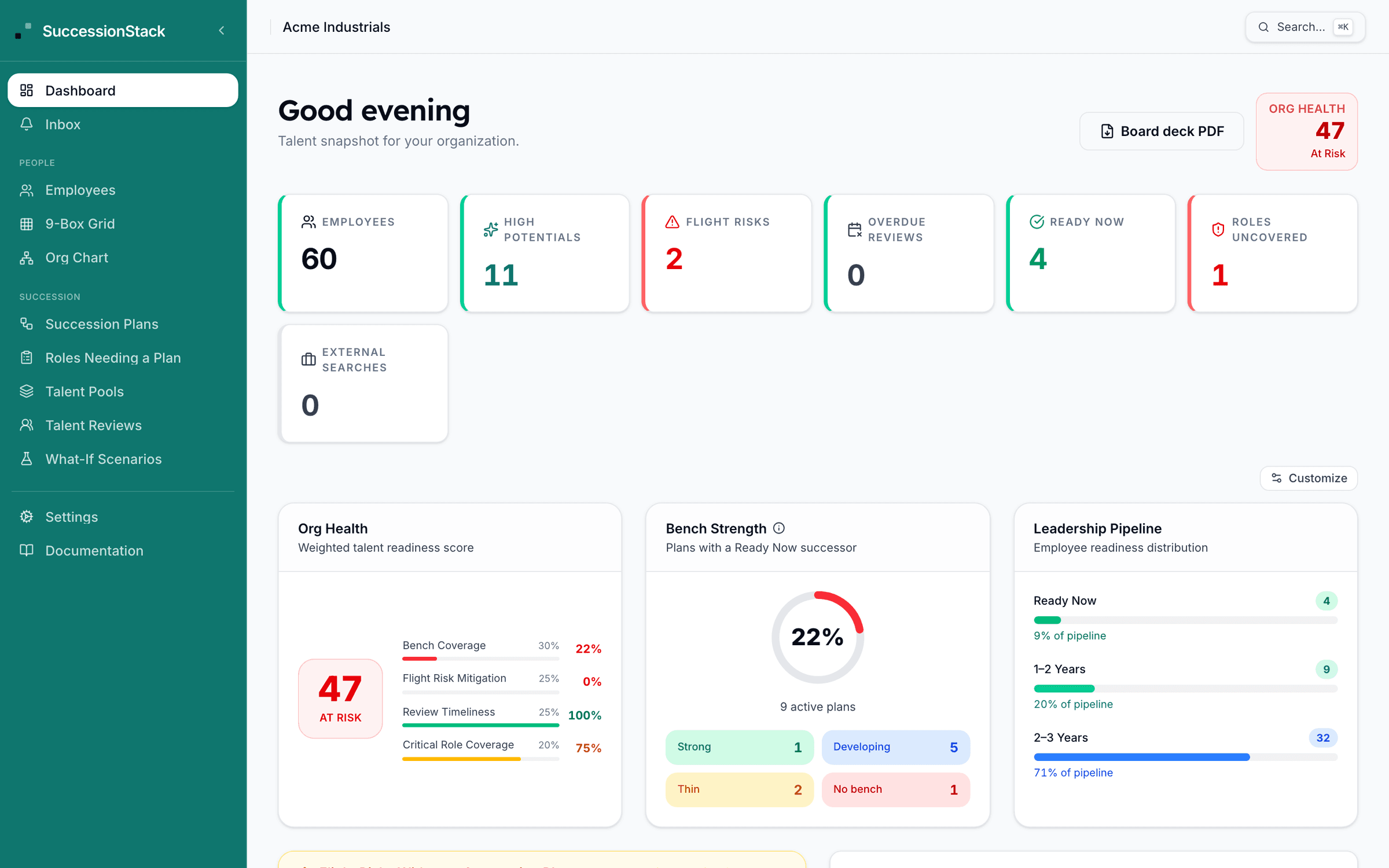
The SuccessionStack dashboard shows bench strength across every plant at once: critical seats flagged, successors scored on eight weighted dimensions (weight safety judgment and floor credibility heavier for plant roles; every weight change is audit-logged), and readiness tracked across three windows so known retirement dates have named coverage. When the plant manager at your largest site gives notice, the what-if model shows the cascade up to three levels down, with an AI narration of what the chain of moves actually costs you. Org health and pipeline analytics sit beside the bench view, so the quarterly ops review and the HR review read from the same page.
How manufacturers get live
Built for HR teams running lean, without an implementation project.
Import the salaried population
CSV export from whatever runs payroll today. Sites, functions, and reporting lines are live within the first week.
Flag the critical seats per site
Plant leadership, maintenance and controls, EHS, quality, and the one-deep specialist roles every site has.
Score against role-weighted criteria
Eight dimensions with weights tuned per role: a plant manager profile is not a corporate engineering profile.
Model the retirements you can see coming
Run the what-if on every known retirement window and fix the thin plans while there is still runway.
Questions buyers actually ask
See where your bench breaks before it matters.
Bring your real org chart. We show you the succession gaps, cascade risks, and bench depth in a 30-minute walkthrough. IT security questions answered on the same call.
IT review first? The FAQs answer the security questions honestly →