Family Businesses
One standard for every candidate, family or not.
Why succession planning is different in a family business
Succession in a family business is never only an HR question. The CEO seat is tangled with ownership, identity, and thirty years of dinner-table history, which is why the decision gets deferred: every year without a plan is a year without a fight. The well-documented result is a transition that happens on the worst possible timeline, triggered by health or conflict rather than readiness, with successors who were never honestly assessed and a company that discovers mid-crisis how much lived only in the founder's head. Structure is the antidote, and structure has to arrive years before the transition does.
The family versus non-family tension is the specific problem to defuse. Strong non-family executives leave when the top job looks pre-decided by birth, and family candidates carry the opposite burden: any promotion is assumed unearned until proven otherwise. The same assessment for everyone changes both stories. When every candidate is scored on the same eight weighted dimensions, with the criteria agreed before names are attached and every change to the weights logged, a family candidate who scores well has evidence, and a non-family executive can see a real path. Neither exists while the process lives in the founder's head.
Ownership and management are separate successions, and conflating them is a classic failure mode. Shares can pass to the next generation while the CEO seat goes to the best operator available, family or not; a family member can chair the board while a professional manager runs the company. Estate planning handles the ownership side. Management succession needs its own discipline: defined critical roles, honestly assessed candidates, development plans with real timelines, and a model of what else moves when the founder finally steps back.
The seats family business plans have to cover
The transition everyone watches is the CEO seat, but the exposure runs wider than the family tree.
The CEO seat and the next generation
The readiness question deserves a real answer, not a birthday. Scoring candidates from the next generation across three readiness windows replaces someday with a development plan that has dates on it.
Non-family senior executives
Your CFO and COO are watching how the succession question gets handled, and their retention depends on the answer. Visible criteria and a credible process keep the professionals you cannot afford to lose.
Founder-held relationships
Key customers, the bank, the critical supplier: decades of relationships often live with one person. Mapping that concentration is the first step to transferring it while the founder is still in the building.
Family members in operating roles
An honest scored assessment does more for a family candidate than a courtesy title ever will. Development plans built against real gaps are how the next generation earns the room's confidence.
One org chart, one standard.
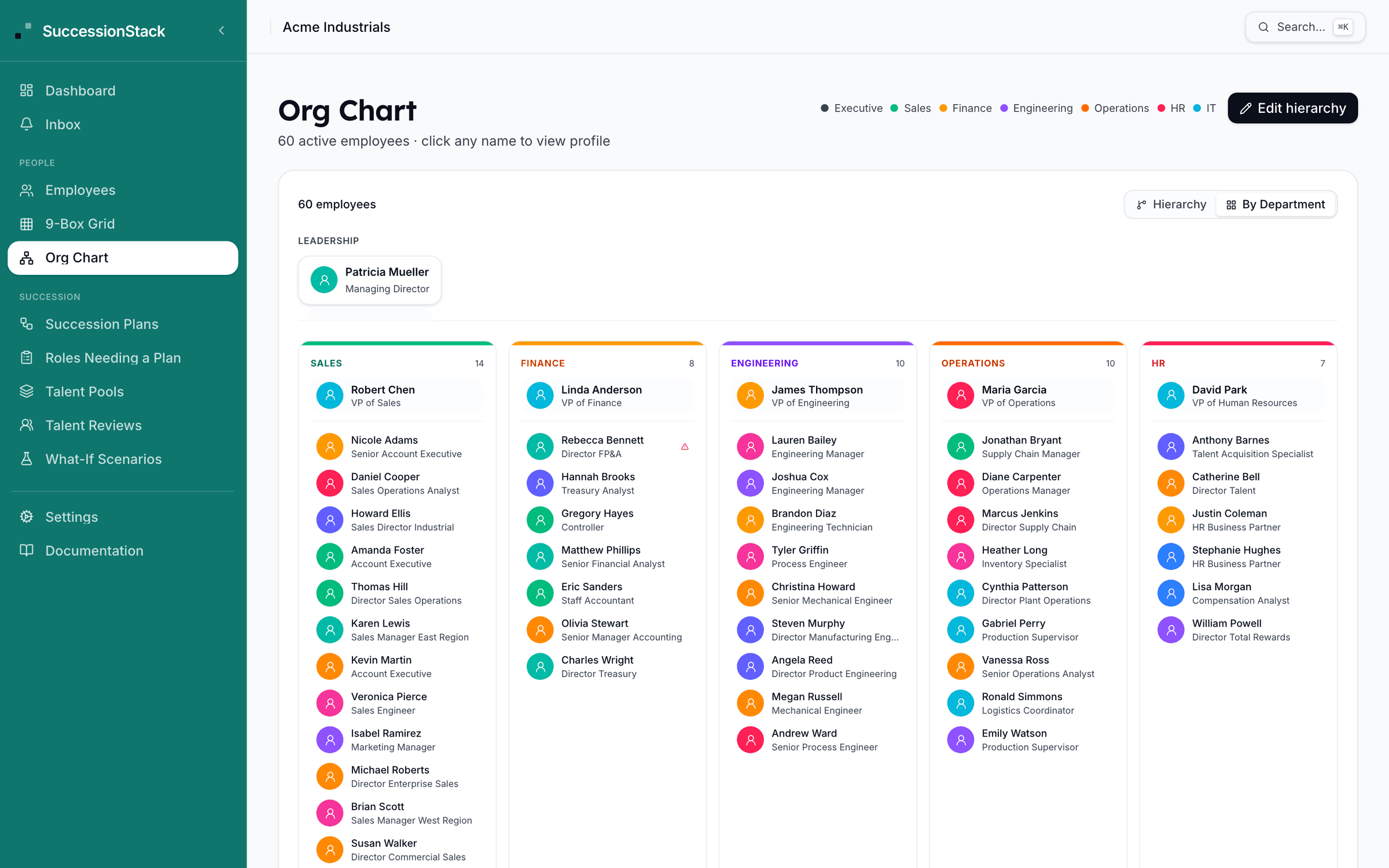
SuccessionStack shows the company as it actually reports, then holds every succession candidate to the same standard: eight weighted dimensions, weights agreed per role, and an append-only audit log so nobody can quietly tilt the criteria after seeing the scores. When the founder transition finally gets modeled, the what-if cascade shows every downstream move up to three levels deep, with an AI narration the whole family can read in plain language.
How family businesses get live
Two weeks from a spreadsheet, and the criteria conversation happens before any names do.
Import the roster
A CSV from payroll or your accountant's system. Structure and reporting lines are live in days.
Agree the criteria first
Set the dimension weights for each critical role before assessing anyone. Deciding what the job needs before deciding who gets it is most of the fight avoided.
Score every candidate on the same scale
Family and non-family, same dimensions, same evidence. The audit log keeps the process even-handed, and visibly so.
Model the transition in daylight
Run the founder-departure what-if, see the cascade, and turn the results into development windows instead of surprises.
Questions buyers actually ask
See where your bench breaks before it matters.
Bring your real org chart. We show you the succession gaps, cascade risks, and bench depth in a 30-minute walkthrough. IT security questions answered on the same call.
IT review first? The FAQs answer the security questions honestly →