Auditable succession planning
Every score, with a reason attached.
What does an audit trail actually mean at mid-market scale?
Most mid-market HR teams don't have a compliance department reviewing succession decisions line by line. What they have is a board member who asks why this person and not that one, a new HR leader inheriting ratings she didn't make, or a skipped-over director who wants a real answer instead of a shrug. An audit trail exists for that moment, not for a regulator's checklist.
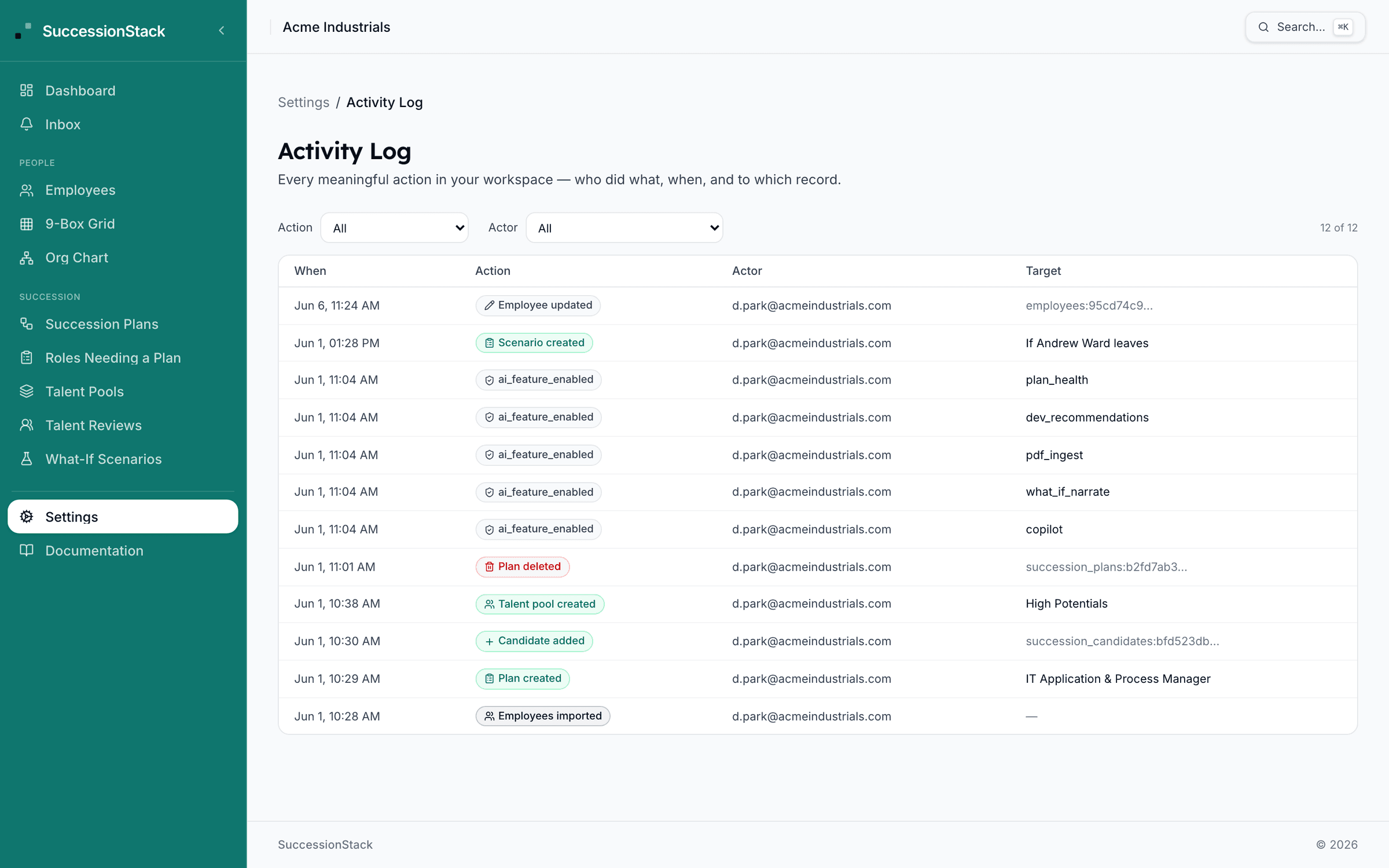
In SuccessionStack, that means every score change and every dimension-weight change carries an actor, a timestamp, and a required reason before it saves. The record is append-only: nothing gets edited away, so the full history of how a rating arrived where it is stays attached to the person, not scattered across old decks and forgotten emails.
This is a different bet than the enterprise-suite version of "auditable," which tends to mean a compliance report generated for an audit committee. Ours means the plan can answer, on the spot, the question mid-market HR actually gets asked: why him, and not her.
Every change, who made it, and why.
Rate a leader on any of the eight weighted dimensions and the reason field is part of the save, not an optional note. Adjust a dimension's weight for a role and the same rule applies. Pull up anyone's record later and the full history is there: not just the current number, but every number it used to be and why it moved.
Four moments the log actually gets used
An audit trail nobody reads is a feature nobody needed. These are the specific moments mid-market HR teams pull it up.
The board asks why him and not her
A director wants a real answer, not a defensive one. The scored dimensions and the dated evidence behind them are the answer, pulled up in the meeting instead of assembled afterward.
The CHRO who made the calls has left
Opinions leave when the person who held them does. A logged reason for every rating doesn't, so the successor in the HR seat can trust ratings she didn't personally make.
A skipped-over leader challenges the call
"Why him and not me" gets a real answer when the criteria were explicit and the gap was scored, instead of a scramble to reconstruct a conversation from six months ago.
A new HR hire inherits last year's ratings
Ratings with no history are just claims to take on faith. Ratings with a reason attached can be checked, questioned, and built on from day one.
An unexplained score is an opinion with a number attached. Ours come with the reason attached too.
- 100%of score and weight changes logged with who, when, and why
- 8weighted leadership dimensions behind every score
- 1required reason field on every edit — no silent changes
How the audit trail actually works
No separate compliance module to configure. The log is the same record the scoring already writes to.
Every score starts with a reason
Rating a leader on a dimension requires a short, specific reason before the change saves.
Weight changes are logged the same way
Adjust how a dimension is weighted for a role and the same actor, timestamp, and reason rule applies.
History stays attached to the person
Open anyone's record and see every rating they've ever carried, not just the current snapshot.
Export it when someone asks
Filter and export the log for a board packet, a new hire's first week, or a challenge that needs a paper trail.
Questions buyers actually ask
See where your bench breaks before it matters.
Bring your real org chart. We show you the succession gaps, cascade risks, and bench depth in a 30-minute walkthrough. IT security questions answered on the same call.
IT review first? The FAQs answer the security questions honestly →