Services vs software
Consultants, software, or both.
Do you need succession planning consultants or software?
Succession planning services usually means one of three things: a consultant who facilitates the process, an assessment firm that evaluates individual leaders, or an executive search firm engaged when the internal answer turns out to be nobody. They solve for expertise and capacity. You are buying judgment and a pair of hands, generally for a defined engagement.
Software solves for continuity. It is where the criteria, the scores, the evidence, and the history live so the work survives the engagement. A consultant produces a strong answer on the day they leave; without somewhere to keep it, that answer decays at the same rate as any other document.
The short version: consultants are worth it when you do not yet know what good looks like, when the decisions are politically hard enough to need an outsider, or when a specific role needs deep individual assessment. Software is worth it when you know roughly what you are doing and the problem is that nothing stays current between reviews. Plenty of organizations genuinely need both, in that order.
Keep what the engagement produced.
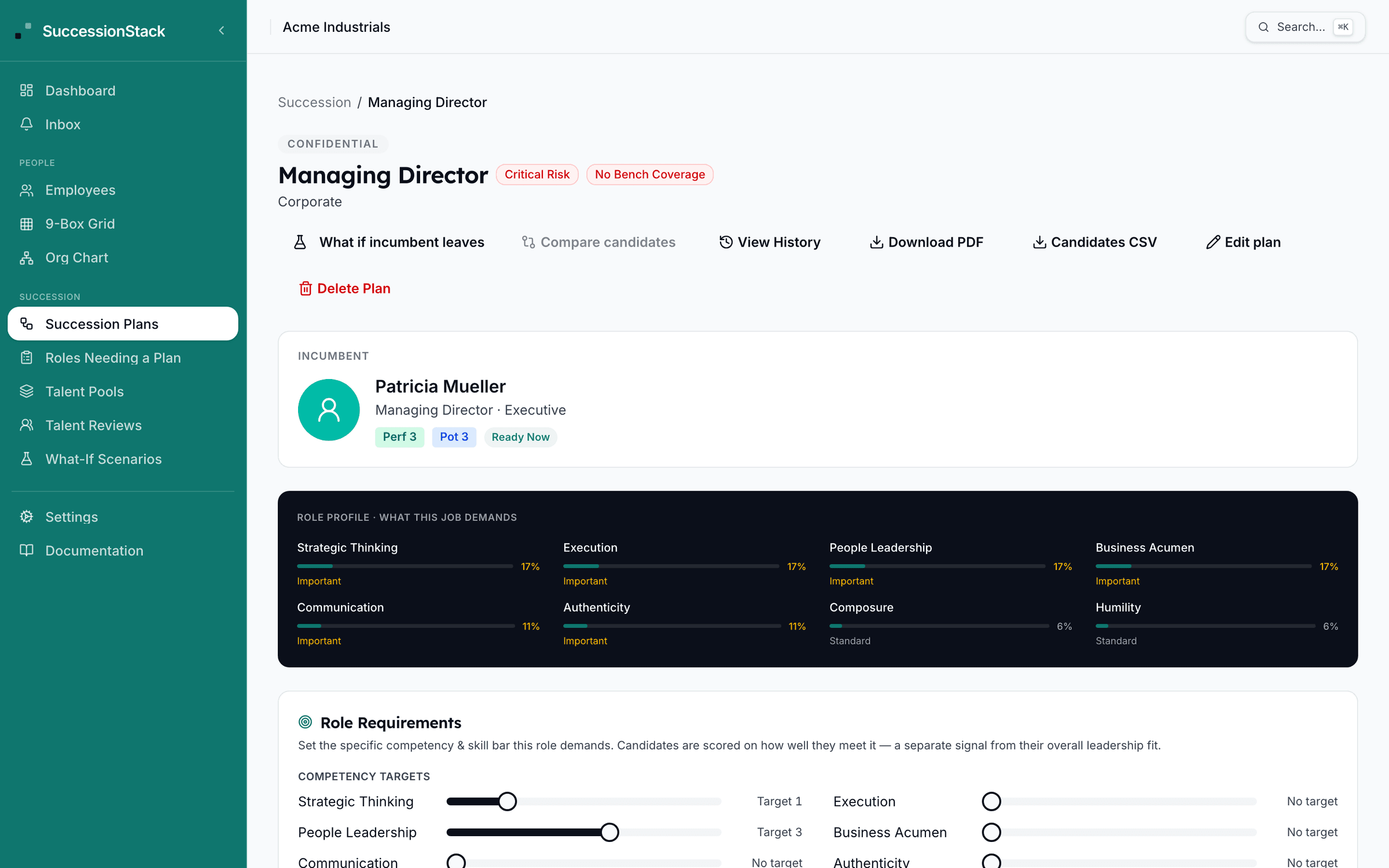
The most common waste in succession consulting is not the fee, it is what happens afterward. Criteria, scores, and reasoning land in a deck, the deck goes in a folder, and eighteen months later the next team starts over. Putting the output into a system that tracks readiness, logs every change, and re-scores as people develop turns a one-off engagement into something that compounds.
Which one does your situation actually call for?
Four common starting points and the honest recommendation for each, including the two where buying our software first would be the wrong move.
You have never done this before
Start with a consultant or a well-structured framework. Software will happily store a bad set of criteria. Knowing what good looks like has to come first, and a free template plus a few weeks of thinking often gets you there.
One critical seat, high stakes, deep uncertainty
That is an assessment engagement, not a software purchase. Individual psychometric and executive assessment is specialist work, and a scoring model is not a substitute for it.
You run the process and it keeps going stale
This is the software problem. You know what you are doing; the plans stop being true between reviews and nobody can reconstruct why a rating moved. More consulting will produce a better version of the same decaying document.
A consultant just finished and left you a deck
The engagement did the hard thinking. The risk now is decay. Getting the criteria, scores, and reasoning into a system is what stops you paying for the same work again in two years.
A consultant gives you an answer. A system gives you a way to keep answering. Buying the second without understanding the first is how tools become shelfware.
- 0consulting services sold by SuccessionStack — we do the software half only
- 1-2weeks to go live from a CSV, without a rollout project
- 100%of score and weight changes kept with the reasoning attached
If you are doing both, what is the right order?
Sequencing matters more than the choice. Most of the wasted spend we see comes from running these in the wrong order or in parallel without a handoff.
Agree what the critical roles require
Whether that comes from a consultant, a framework, or your own leadership team, the criteria and their weights need to exist before anyone is scored.
Do the hard assessment work
This is where outside expertise earns its fee: honest evaluation of individuals against the criteria, especially where internal politics make candor difficult.
Put the output somewhere it survives
Load the criteria, weights, scores, and reasoning into a system rather than a deck, so the next HR leader inherits something checkable.
Run it yourself from there
Re-score as people develop, log why ratings move, and pressure-test the bench. Bring the consultant back for the genuinely hard calls, not for maintenance.
Questions buyers actually ask
See where your bench breaks before it matters.
Bring your real org chart. We show you the succession gaps, cascade risks, and bench depth in a 30-minute walkthrough. IT security questions answered on the same call.
IT review first? The FAQs answer the security questions honestly →