Succession management
Planning is the exercise. Management is the habit.
What is the difference between succession planning and succession management?
Succession planning is the exercise of identifying and developing people who could step into critical roles. It has a start and a finish: you pick the roles, assess the candidates, write the plans. Succession management is the ongoing discipline of keeping those plans accurate as the organization changes underneath them.
The distinction matters because the failure mode is almost never the planning. Teams run a serious process, produce a real document, and then the document stops matching reality. People get promoted, leave, change their minds, or quietly become ready. Nobody updates the file. Within a year the plan describes an org that no longer exists, and leaders stop trusting it long before anyone admits it out loud.
Large HCM suites tend to use "succession management" as the name of a module. We use it as the name of a behavior: re-scoring readiness on a cadence, recording why a rating moved, and pressure-testing the bench before a departure rather than after one. A module you open twice a year is still a planning tool, whatever it is called.
Readiness that moves when people do.
A successor who was two years out in January may be closer now, and the plan should know. Re-score any leader against the weighted dimensions their target role actually needs, and the bench view updates immediately: who is Ready Now, who moved a window, which roles just went thin. No annual rebuild, no reconciling three versions of a deck.
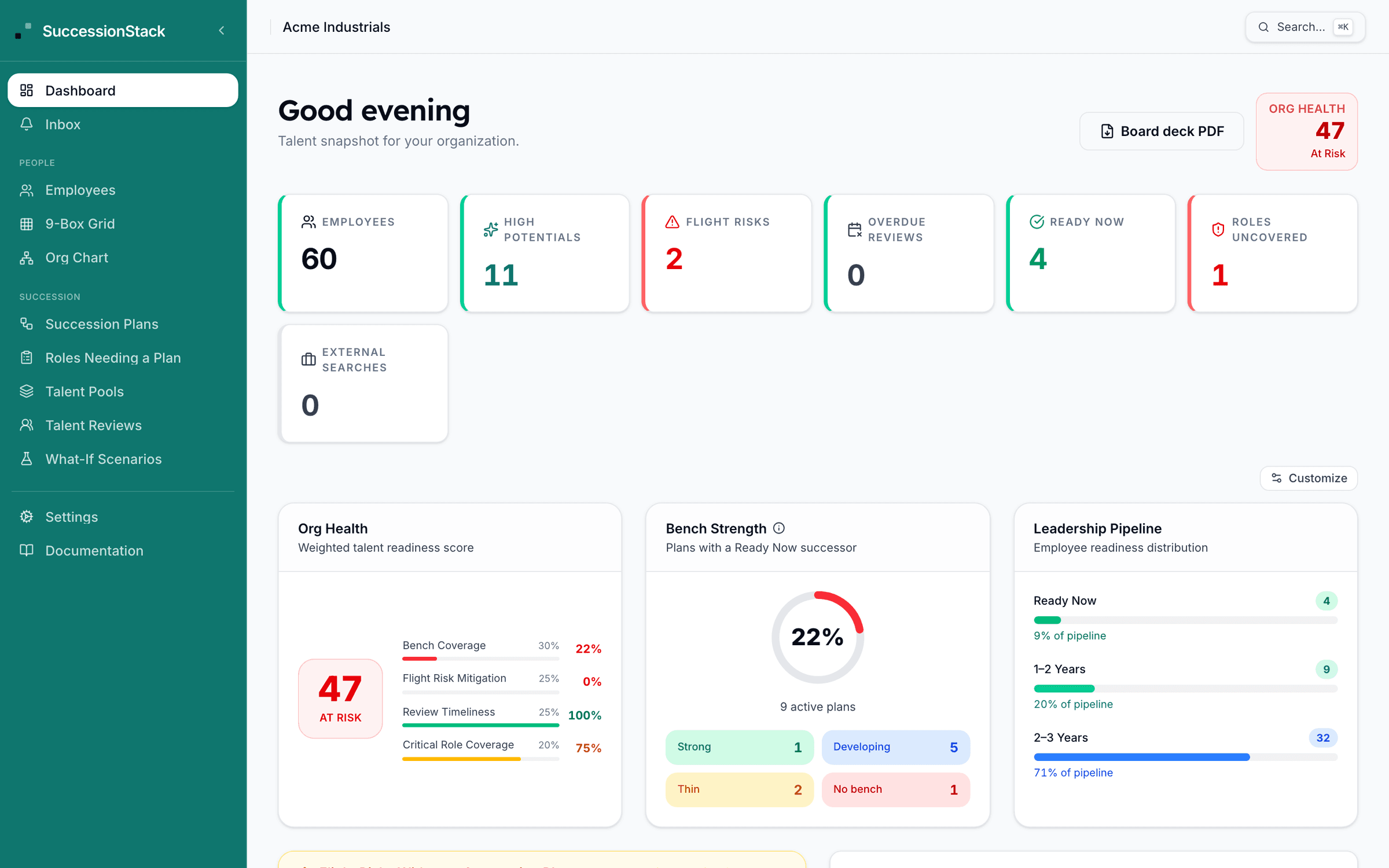
Four ways a good plan goes stale
Decay is rarely dramatic. It happens through ordinary organizational movement that nobody thinks to record, which is exactly why it goes unnoticed until the moment the plan is needed.
The successor gets promoted elsewhere
Your named backup for the COO seat took a bigger job in another division. The plan still lists them. Nobody removed the name because nobody owned the file.
The readiness window rolls forward forever
Someone has been "ready in two years" for four years running. The window moves with each review because nothing was ever developed against a specific gap.
One person quietly backstops five roles
The same strong director appears as the successor on several plans. On paper the bench looks covered. In practice one resignation empties all of it at once.
The ratings outlive the rater
The HR leader who made the original calls has moved on. The scores remain, with no record of the reasoning, so the successor in the seat inherits numbers they cannot check.
A plan that is right once and wrong forever is not a plan. It is a document about the past.
- 8weighted leadership dimensions you can rename, reweight, and reorder per role
- 100%of score and weight changes logged with who, when, and why
- 3readiness windows tracked per candidate: Ready Now, 1 year, 2-3 years
What does succession management look like in practice?
Four habits, run on a cadence rather than in a single annual push. Each one is a small piece of work that keeps the whole picture honest.
Re-score as people grow
Readiness is a moving number. Update it when someone completes a stretch assignment, not at the next annual review.
Keep the reasoning on the record
Every score and weight change carries an actor, a timestamp, and a required reason, so ratings stay checkable after the people who made them move on.
Pressure-test before you need to
Model a departure and watch the cascade: who steps up, which plans go thin, where the org is suddenly one-deep.
Review on a fixed cadence
A quarterly touch on each critical role and a twice-yearly full review keeps the bench current without turning succession into a standing project.
Questions buyers actually ask
See where your bench breaks before it matters.
Bring your real org chart. We show you the succession gaps, cascade risks, and bench depth in a 30-minute walkthrough. IT security questions answered on the same call.
IT review first? The FAQs answer the security questions honestly →