Business succession planning
Two handoffs, not one.
What is business succession planning?
Business succession planning is the work of preparing for a change in who owns and who leads a company. Those are two separate handoffs, they run on different timelines, and they have different right answers. Ownership can pass through an estate years after leadership has already changed hands, or leadership can move to a professional manager while ownership stays exactly where it was.
Treating them as one question is the most common and most expensive mistake in the category. Businesses that conflate them usually end up with a clear answer about who owns the company and no answer at all about who is capable of running it. The ownership question feels more urgent because it has documents attached; the leadership question is the one that determines whether the business survives the transition.
The ownership side genuinely belongs with a company's lawyers, accountants, and financial advisors. Buy-sell agreements, share structures, wills, trusts, and the tax consequences of each are specialist work, and no talent tool should pretend otherwise. What we do is the other half: establishing what the top jobs actually require, assessing candidates against that honestly, and closing the gaps before the handover rather than during it.
One standard for every candidate.
The hardest part of a leadership handover is assessing someone you are close to. Scoring candidates against explicit, weighted criteria for the role removes the part of the conversation that runs on relationship and history. Family member, long-serving general manager, or outside hire, everyone is measured the same way, and the gaps are named rather than implied.
Where the leadership handoff breaks
Ownership transitions fail on paperwork, which is why advisors exist. Leadership transitions fail on readiness, and the patterns are consistent enough to plan against.
The successor was chosen but never assessed
Being the obvious candidate is not the same as being ready for the job. Skipping the assessment because the answer feels settled is how a capable person gets set up to fail in public.
Development never started
The handover date is known years ahead and the gap-closing work still begins six months out. Readiness is built through exposure over years, not through a transition plan written at the end.
Nobody planned the second layer
The top seat gets all the attention while the roles directly beneath it have no cover. Promoting the successor empties their old job and nothing behind it was ready.
The decision was never written down
Everyone believes they know the plan and no two people describe it the same way. A succession that lives in conversation is not a plan, it is a shared assumption.
Ownership and control are not the same decision. Separating them early removes the assumption that the largest shareholder has to be the one running the company.
- 2distinct handoffs in any business succession: ownership and leadership
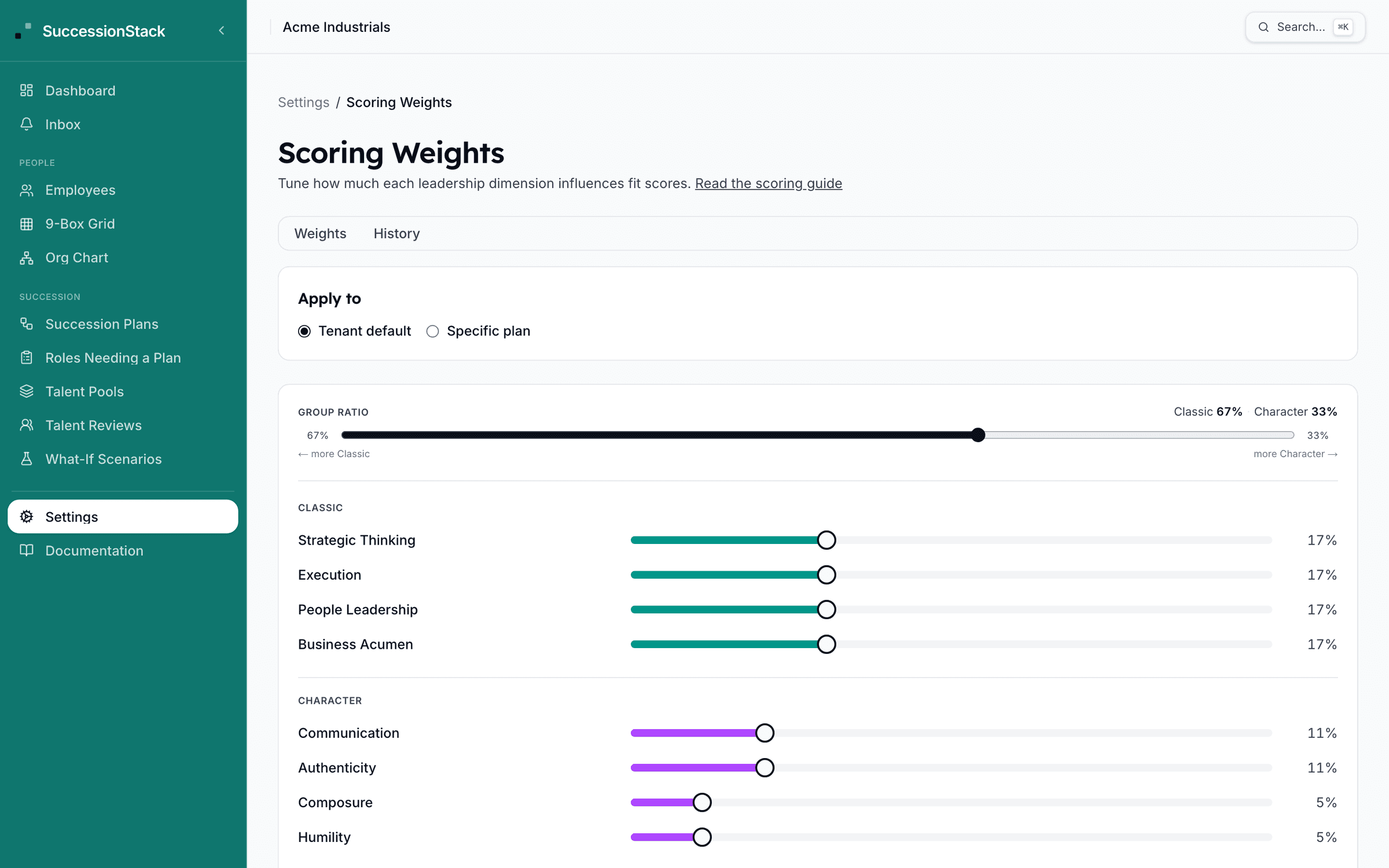
- 8weighted leadership dimensions, renameable and reweightable per role
- 1standard applied to every candidate, related to the owner or not
How do you plan the leadership half?
The ownership track runs with your advisors on its own schedule. This is the track that decides whether the business is still working the year after the handover.
Name the roles, not just the top one
Start with every seat where a sudden vacancy would stop revenue or break a key relationship, which is usually more than the top job and fewer than the whole org chart.
Define what each role actually requires
Set the criteria and their weights before anyone is scored against them. Criteria written after a name is in mind tend to describe that person.
Assess candidates on the same terms
Score family and non-family candidates against identical criteria, with a sentence of evidence behind each rating rather than an adjective.
Close the gaps on a schedule
Turn each scored gap into a development action with an owner and a date, then re-score as the work lands so readiness reflects what has actually changed.
Questions buyers actually ask
See where your bench breaks before it matters.
Bring your real org chart. We show you the succession gaps, cascade risks, and bench depth in a 30-minute walkthrough. IT security questions answered on the same call.
IT review first? The FAQs answer the security questions honestly →